
Previously on I Built The Sky
I’ll admit I went into this conversation expecting the usual talk of gear, riffs, and technical wizardry — Rohan Stevenson is, after all, one of the most talked-about names in Australian instrumental prog right now. What I didn’t expect was how quickly the conversation turned toward something rawer. Promise Me You’ll Thrive, the new I Built The Sky record, started life during a solitary retreat on the Victorian coast, got scrapped almost entirely, and was eventually rebuilt under the kind of deadline pressure that either breaks a project or forces it into focus. For Stevenson, it was the latter.
What struck me most, though, was hearing him speak so openly about the emotional place he was writing from — somewhere dark and heavy enough that he still isn’t sure exactly what to call it. Rather than let that weigh the album down, he channeled it into what he describes as his most personal and hopeful work yet, built out with a lineup of collaborators and produced by Forrester Savell, whose credits include Karnivool and Tesseract.
I sat down with Stevenson to talk about writing without a safety net, letting go of control just enough to let his collaborators shine, and what it actually means to “thrive” when you’re the one who has to define it for yourself.
An Interview with I Built The Sky’s Rohan Stevenson
You wrote much of this album during a month-long retreat in coastal Victoria before finishing it under deadline pressure at Airlock Studios in Brisbane — how different did the album end up sounding from what you first imagined during that retreat?
Rohan Stevenson: All the music I wrote in the first sessions in Manns Beach were scrapped. That was because I was trying to capture a very specific emotion which really took shape once I got the title. So I think what I ended up with was what I wanted all along. I just didn’t know how to get there. In the end, the key was in the title which was something I constantly referred to while creating.
You’ve said “the pressure forced clarity” when it came to finishing tracks right before drum tracking began. Can you walk us through a specific song that came together that way?
Rohan Stevenson: I booked the drum tracking session when I had almost no material. I knew it would inspire forward momentum and it really did. I think I work best when I’ve got a goal set and something to work towards. So yeah, basically 90% of it was written under this circumstance.
Was there a moment during that crunch period where you thought a track might not make the record?
Rohan Stevenson: Yes, the song Upward Spirals was written in the final few days before tracking drums. I called Dave to ask if he could manage 1 more song so close to recording date, to which he happily obliged. I really wanted a 10 song album. As soon as he said yes, I got to work and fleshed it out and sent it to him to learn. It ended up having one of my favourite sections on the entire record.
Promise Me You’ll Thrive is described as your most emotionally charged release yet — what was happening in your life that pushed the album in this direction?
Rohan Stevenson: I was struggling when I went into it. I don’t know if it was depression but it was definitely something along those lines. I was feeling dark, hopeless and sad. I really just needed something to focus on that makes me happy so I wrote the album. It was something for me in a way to help bring myself out of those feelings and eventually my message to the world. I just want to share something filled with positivity to try and lift and inspire others too.
Without lyrics to lean on, how do you approach telling an emotional story purely through instrumental composition?
Rohan Stevenson: Absolutely! I think theres a lot of emotion to be had in music without lyrics and I think the storytelling element comes from how you present it. Where the music takes you and how the journey of the structure unfolds. I like to have fun creating music that feels like it takes you on a journey with lots of different feelings embedded and that, to me, is the art of instrumental music.
RELATED: An Interview with ‘The Forever Home’ Writer: Christian Ward
The title track carries a real sense of a personal promise. What does “thriving” mean to you right now, versus what it might have meant when you started this project?
Rohan Stevenson: Thriving to me is really just about combatting dark feelings and harnessing positive energy to live life. I don’t think the meaning changed at all for me.
This is a stacked lineup — David Parkes, Toby Peterson-Stewart, Rohan Sharma, and Jake Willson. How did you divide creative control, especially with Jake composing the string arrangements?
Rohan Stevenson: Creative control always lies with me. I get the final say and dictate the direction of the music. It’s not a typical band dynamic and thats how this project functions. Having said that, everyone involved is at such a high level and on the same page as me that their creative input is ever-present and shining through the album.
In a more practical sense, I write full demos of the songs which I then send to anyone involved. They then take those ideas from each instrument to then do their thing with and add their unique voice and ideas into. Sometimes that’s done in real time together and sometimes that happens without me being there but in the end I will listen to what they send back and give it the ‘okay’ or suggest we take it in a different direction.
What did working with Forrester Savell bring to this record that you couldn’t have gotten elsewhere, given his history with bands like Karnivool and Tesseract?
Rohan Stevenson: Forrester is incredible with anything to do with audio. I definitely feel like he is my secret weapon in the production process as he is the one that really gives the listener the best presentation of the songs.
There’s a lot of creativity involved within the mix and master as he needs to decide what will draw focus in that moment. Sometimes this is obvious because it’s a guitar solo but other times with the amount of layers going on he needs to decide what is prioritised and what might take a back seat. So yeah, he is a big part of it all and I love everything he does and what he brings to my projects.
Rohan Sharma’s connection to Jordan Rudess is a great pedigree — how did his synth and keys change the textures on this album compared to previous I Built The Sky records?
Rohan Stevenson: This was Rohan’s first time being on a record of mine. He added a lot in terms of textures and effects on top of the more obvious keys and synth work. Some of the highlights come from his input.
Pat Fox’s album art tells a striking story — the suited figure surrounded by fire, reaching for a bird. How much creative direction did you give him, and what does that imagery mean to you?
Rohan Stevenson: The album cover is supposed to represent the notion of focusing on the good and not the bad despite everything. We took a bit of time trying to reach that idea but once we had it, Pat took control to bring it to life. This meant a lengthy photoshoot with myself and a lot of work creating the elements and putting it together. I absolutely love how it turned out.
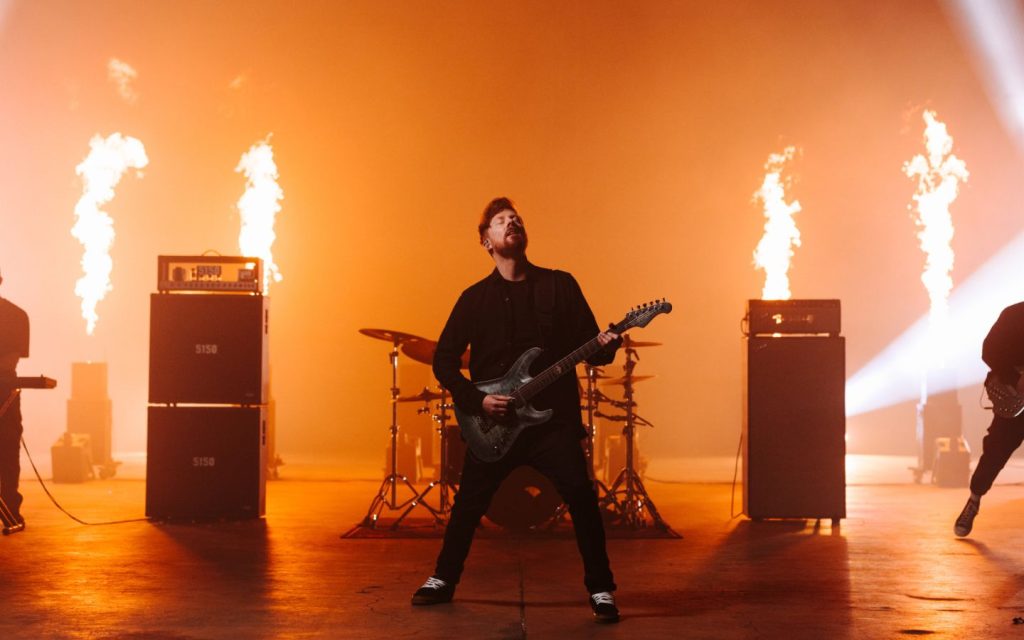
The Start of Something Beautiful video with Colin Jeffs is described as your most visually ambitious yet, with pyro. What was it like translating the album’s themes into that visual language?
Rohan Stevenson: It was super fun, and i loved the end result, we didn’t over think it but we did have key ideas we wanted to explore. I love how it turned out.
Guitar World called you part of “Australia’s best in the prog-sphere” — how do you see I Built The Sky’s place in that scene right now?
Rohan Stevenson: That was actually a quote from Triple J radio station. I don’t really know? I don’t like to analyse that stuff. Anything external to what I can control is just not really my business. Hopefully people enjoy what I do and support it enough that I can keep going.
With over 70 million streams as an instrumental act, why do you think this music connects with people who might not typically listen to prog?
Rohan Stevenson: I think what I do hits a sweet spot between musicality and song-craft. Ultimately, my focus is writing good songs and not being the fastest shredder or guitarist. So, I think that translates on the other end where listeners might appreciate the musicianship but not necessarily need to be a musician to enjoy it.
You’re planning to expand live performances internationally after this release — what does an I Built The Sky live show need to capture that the album can’t?
Rohan Stevenson: Live and recorded music are completely different. I approach the two in vastly different ways. You become a performer and an entertainer rather than purely a musician. There’s a lot of energy and excitement to harness and stage craft to make it all work. So yeah, I like to make shows a really unforgettable experience by selecting the right songs and shaping the set list by giving people something special that they can’t get from the album alone. It’s a lot of work but among the best things you get to do as a professional artist.
Looking at the track list, is there one song you’re most nervous or excited for people to hear, and why?
Rohan Stevenson: Nah, I never worry about that stuff. I do get curious as to what people might connect with over other things. I have an idea of what I think people will like but sometimes what people end up liking the most – is something I didn’t expect.
Follow I Built The Sky on Social Media
I Built The Sky on Instagram>>
More Interviews on Soda and Telepaths
- An Interview with ‘Voltessa: Masquerade of the Macabre’ Creator: Justin Gray
- An Interview with ‘Blam & Glam’ Creator: Richard A Morgan
- An Interview with the Creator of ‘Boston Metaphysical Society’: Madeleine Holly-Rosing
- An Interview with the Creator of ‘Night Ghost’: Lee Saunders