Previously on Sole Mate
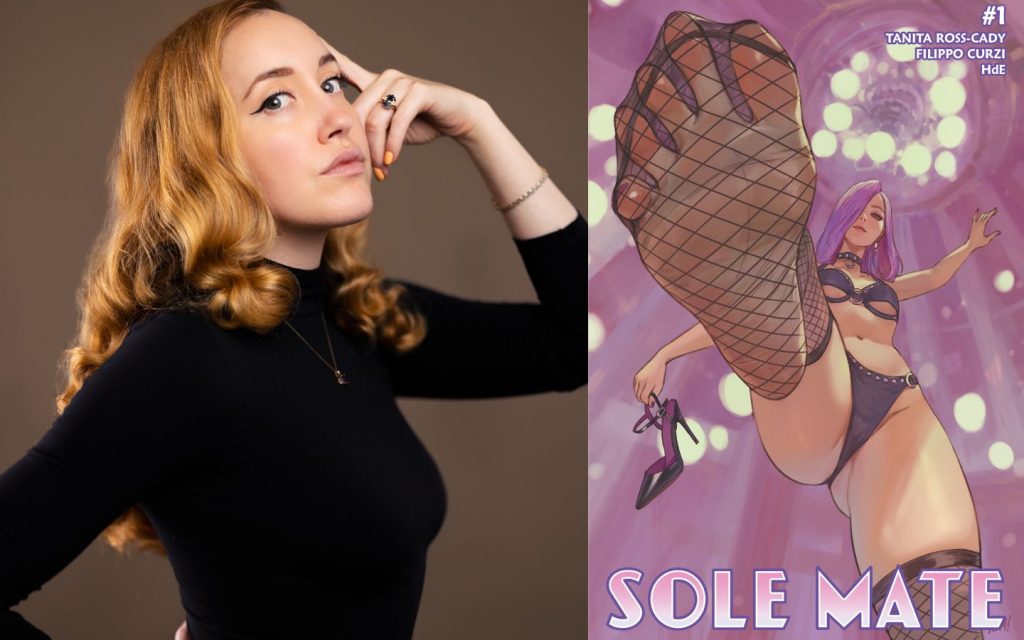
Tanita Ross-Cady — former circus performer, podcaster, and founder of Limina Studio — writes from a life most people would call unbelievable, and she’s the first to agree. Her new project, Sole Mate, is a Tarantino-esque erotic thriller following Maeve, a performer whose career-ending injury pushes her into 1990s Seattle’s underground foot fetish scene, where she collides with a jealous rival and a CIA agent whose obsession turns predatory. Illustrated by Filippo in saturated, cinematic detail, the story has already carried its Kickstarter campaign to achieve well past its funding goal.
In this interview, Ross-Cady and I spoke about her fearless adolescence, a formative encounter on a Seattle bus, and a lifelong pull toward hidden worlds both underground and paranormal. She talks about writing a genuinely anti-heroic lead, why women make more compelling antagonists than men, the research behind foot fetishism’s psychology and stigma, and the deliberate wink to Tarantino’s own fixation with feet on screen. The result was a conversation as unfiltered as the book itself.
Please note: This interview occurred mere hours before the Sole Mate Kickstarter ended.
An Interview with Tanita Ross-Cady about Sole Mate
Most writers would have taken their protagonist to rehab or therapy. Why did you decide the underground fetish scene was the more interesting place to send Maeve?
Tanita Ross-Cady: Unwanted forced life transitions slam us into uncomfortable new worlds of uncertainty, but discomfort is essential for our evolution. The foot fetish underground was the perfect place to send Maeve because it’s totally opposite from the existence she’s been living – she moves from the stage into the dungeon. It’s the last place she thought she would end up… But it also makes perfect sense. The unknown becomes a delicious place to explore, it gives her the stimulation she’s been craving.
The tagline says “self-discovery is best explored in the dark.” How much of Sole Mate is you working something out personally?
Tanita Ross-Cady: I’m always processing my personal experiences through writing, but Sole Mate is by far the most honest story I have ever written. A lot of my life is woven into the world in which this story lives. When I was a teenager, I rarely felt fear. I welcomed danger like it was a twisted mentor. There was a constant inner dialogue of “Is this going to kill me? No? Then do it! What’s the worst thing that could happen? You’ll live to tell the tale.”
Because of this, I did a lot of exploring in the dark. I found that the underground was one of the most honest places I had ever witnessed and I grew to greatly admire that honesty. Most people feel shame and fear so intensely that it keeps them from taking any big chances. That part of my brain seems to be shut off. I’ll keep exploring in the dark as long as I’m alive. I have lived a life that most people would not dare to experience. It’s been beautiful. It’s been insane. I’m grateful for every moment.
You were a circus performer in your 20s — before you became a writer. Is there something about bodies being a spectacle, being admired and objectified for what they can do physically, that connects your past life to Maeve’s story?
Tanita Ross-Cady: Majority of the stories I have written, I am gazing into a broken mirror. I see Maeve in the reflection of this mirror. She has healed me in a lot of ways. We have both found the strength to keep going despite tragedy and trajectory shifts. My circus performance life came to an end before I wanted it to, and I still feel the pain of not being a performer to this day. I’m plagued by a fantasy I never had the chance to fully explore. That wound is felt throughout all the stories I create.
I am forever in awe of the astounding feats our bodies are capable of when we push them. There’s something so powerful about commanding a crowd’s emotions when you are performing. If you’ve never been in front of a crowd with all the focus on you, you should try it sometime. It’ll teach you things about yourself that you can’t learn any other way.
RELATED: An Interview with ‘Blam & Glam’ Creator: Richard A Morgan
The 90s Seattle setting feels almost like a third character — grunge, emerging tech, and an underground fetish scene all colliding. What drew you to that specific moment in that specific city, and how does the city’s rot and ambition mirror Maeve’s arc?
Tanita Ross-Cady: I like writing stories based in the 90’s because I miss that last sweet spot in human history where cell phones hadn’t destroyed our attention spans and anonymity. In the 90’s you couldn’t pop an address into your GPS if you wanted to find the underground. You had to be observant of your surroundings. You had to accost someone dressed in leather. You had to know someone, you had to go on a scavenger hunt around the city for clues. You had to work for it.
I’m from Washington state originally, I grew up running around Seattle in my early twenties. I still think Seattle is the most unique major city on the west coast. It has a culture that is unlike anywhere else I have ever been. People are so fucking honest and proud of who they are. Combine this with the tech boom, it brought in a wave of forward thinking professionals, new technology, and money.
Seattle was the location of the innovative minds and driving forces that changed our relationship with computers forever. But don’t let the geeks fool you, they’re freaky as hell. I knew that by placing Maeve in this era and city, she would get the intellectual stimulation she needed as well as a strong dose of how unapologetically real people are in the underground. She needed to witness joy in authenticity to evolve into the most honest version of herself.
Arch Angel is described as someone who wants to destroy Maeve for usurping the throne. That’s a very classical villain motivation — jealousy dressed up in righteousness. What makes a woman-on-woman power struggle more interesting to you than the more obvious threat?
Tanita Ross-Cady: The way that women go to war is a lot more psychological. They will find extremely creative and vindictive ways to destroy your life if they’ve made a decision you’re a threat. You anticipate that a man will be able to physically overpower a woman fairly easily, it’s obvious. By having a female antagonist, it leaves more room for the power struggle to feel nuanced, complex, and more unpredictable to escalate.
The deranged CIA agent spiraling into predatorial obsession is a very specific kind of menace. What research, real or imagined, went into writing a man whose professional training makes him more dangerous as he unravels?
Tanita Ross-Cady: I’ve been obsessed with the alphabet agencies and secret government departments that operate above the law all of my life. When I was a teenager I read a lot of books about MK Ultra, the inception of the CIA, weapons technology, psychic warfare, secret research facilities and so on. There is something so innately fascinating to me about hidden worlds that exist among us, the inner circles that are intentionally kept away from the public eye.
A lot of my stories contain characters and elements of military or government officials because these are the people that both protect and destroy us, and we have absolutely no say in the matter. I made Edward a CIA agent because I wanted his dangerousness to feel palpable, he’s clever, calculated, sneaky, entitled, and he has the resources to be an absolute menace in a way that a normal stalker does not. Most importantly, he has friends that can assist him.
Sole Mate is being described as a Tarantino-esque erotic thriller. Tarantino gets a lot of credit for fetishizing feet on screen without ever really being held accountable for it. Is that a conscious wink?
Tanita Ross-Cady: It’s absolutely a conscious wink. And I’m determined to get him a copy of Sole Mate when the campaign is finished. I grew up on Tarantino movies and I am deeply inspired by him. People dislike his films because of their brash, disturbing, and violent storytelling, but whether you love him or hate him, you leave his movies feeling emotionally moved.
I don’t like films with happy endings where everything is flowery and everyone wins, that’s so unbelievably boring. I want to feel devastated, shocked, inspired in ways I didn’t know were possible, or really turned on after I’ve spent my precious time consuming a movie. Tarantino does this beautifully, I’m just trying to make him proud every day.
The 90s was an incredible time for erotic thrillers. Basic Instinct, Jade, Indecent Proposal, I could go on forever. But I’m curious if you see any classic 90s films in the DNA of Sole Mate?
Tanita Ross-Cady: Yes. I was very inspired by famous 90’s erotic thrillers and other 90’s classics like Basic Instinct, Showgirls, Wild Things, Silence of the Lambs, True Romance, Heat, Thelma and Louise, LA Confidential, Eyes Wide Shut, Fear, and Cruel Intentions.
RELATED: The Psychology of Kink: An Interview with Rachel Rampage
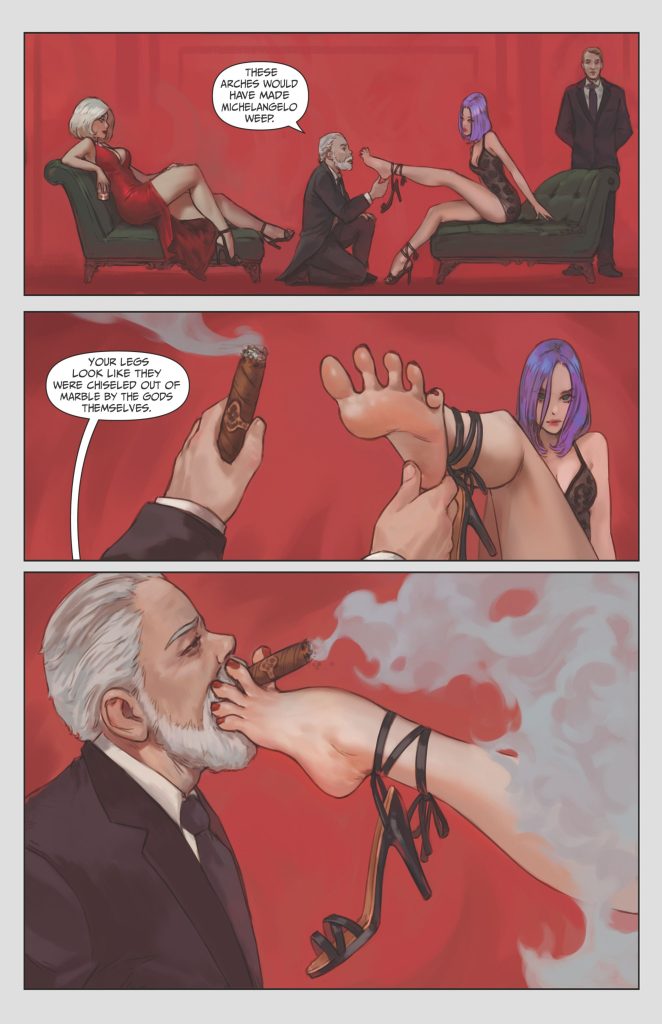
Gianna — the “big tittied fetish club bartender with endless attitude” — feels like she’s doing a lot of emotional heavy lifting in this story. How do you write a character who’s that unapologetically herself without turning her into a sidekick?
Tanita Ross-Cady: Gianna is assisting Maeve in stripping away everything that no longer serves her. She’s doing heavy lifting but their dynamic feels like a delicious ying and yang, a bodacious push and pull. Gianna is both the angel and the devil on Maeve’s shoulder. Everything that Maeve has been hesitant to do, Gianna is already fearlessly in the pool. She’s not a sidekick, she’s combative, she stirs the pot, she’s unapologetically herself. Gianna is the only person in Maeve’s life who will call her on her bullshit, but the love they have for one another is unmistakable. We all need a Gianna in her life.
You’re publishing through your own company, Limina Corp. Would you like to tell my readers more about your organisation and what you strive to achieve?
Tanita Ross-Cady: Because of LLC logistics I have to change all my public information about my company – It is now Limina Studio. So if we could just forgo this question for now until I sort all of that out that would be better. I’m slammed with work and it’ll probably be a little bit until I have all that sorted.
Your Kickstarter has already hit over 1100% of its funding goal. Does that kind of response change anything about where you’re willing to take the story, or does it make you more protective of the original vision?
Tanita Ross-Cady: From the beginning, I wrote Sole Mate with screen in mind. My mission has always been to make Sole Mate so popular that it becomes a live action series. That is the clear goal I am working towards so the recent success of the campaign doesn’t change anything about where I’m going with it. In general I try not to feel too protective about anything I create. The more you tighten your grip on something the more it flies away. I have written so many different kinds of stories, I love all my darlings, Sole Mate is just one tool in the tool belt.
Your earlier work — ‘Estranged Behaviour’, ‘The Craigslist Chronicles’ — leans heavily into the anomalous and otherworldly. Sole Mate feels grittier and more human. What shifted?
Tanita Ross-Cady: Estranged Behaviour and The Craigslist Chronicles are some my publicly released publications, but I have written a lot of TV pilots and screenplays that center around sex work, underground communities, revenge, and other nonesoteric works based completely in reality. All in all I definitely ping pong back and forth mostly between anomalous and sexual stories though.
Foot fetishism is one of the most common and most mocked kinks in popular culture. What did you need to understand about it — its psychology, its community, its hierarchy — before you felt you could write about it with any real authority?
Tanita Ross-Cady: One of the biggest things I’ve learned through the research of this process is how many men AND women secretly love feet, even if it is one of the most mocked fetishes. I had my first unexpected foot worship experience at 18 when I was taking the bus home from work and a random man offered to give me a foot massage and ended up putting my foot in his mouth right there on the bus. One day I’ll write the elongated version of this story but it definitely became a core memory. This began a fascination with the foot for me.
Through my research I’ve discovered there’s an enormous amount of shame surrounding the foot, as well as roots in Freudian philosophies that attraction to the foot goes back to the mother. Big surprise. Beautiful clean feet are perceived as a sign of wealth and health, while unkempt feet can be a sign of poverty and disease. There are subliminal reasons why feet attract and repel us. I felt that I could write this story with authority because I have personally lived a lot of it.
RELATED: An Interview with the Creator of ‘Night Ghost’: Lee Saunders
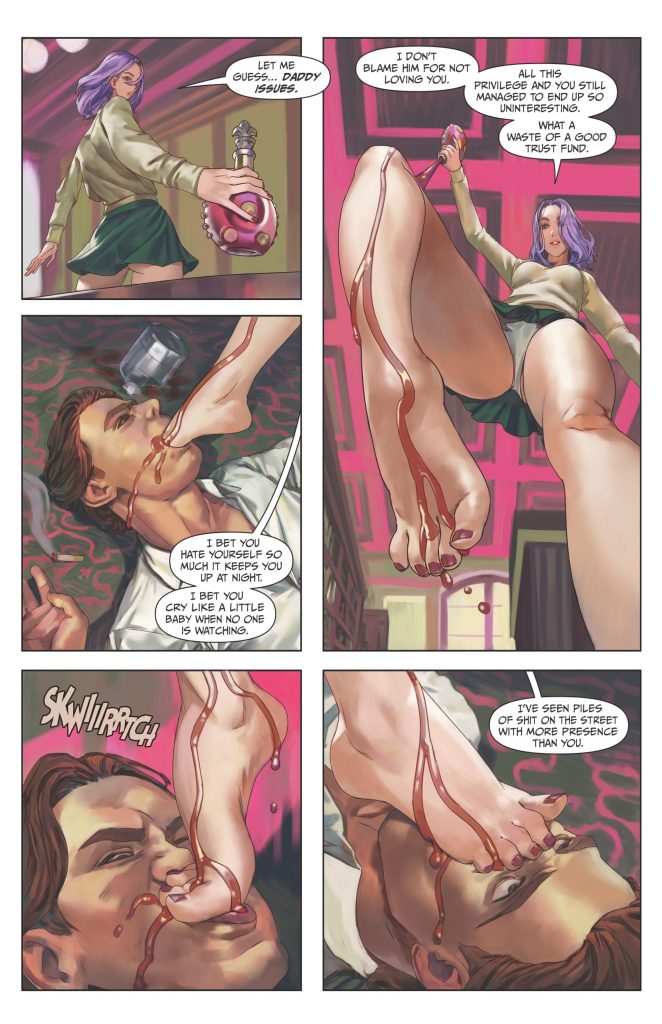
Maeve is described as someone who “rejects the rules of society and discovers who she really is in the shadows.” That phrasing could describe a villain just as easily as a heroine. Is she a heroine or do you see her as more of an anti-hero?
Tanita Ross-Cady: She’s the perfect anti-hero in my eyes. She’s a little bratty with a cynical world view but has recently been humbled by her injury. She’s got plenty of courage, but she’s in uncharted territory trying to make due with a dire situation.
The backdrop of the foot fetish underground makes her an extremely morally grey character, she’s balancing the need to figure out how to pay medical bills and make her life work, while also yearning to feel stimulated and inspired by her circumstances. I’m sure she’s some sexually frustrated housewive’s worst nightmare. Good.
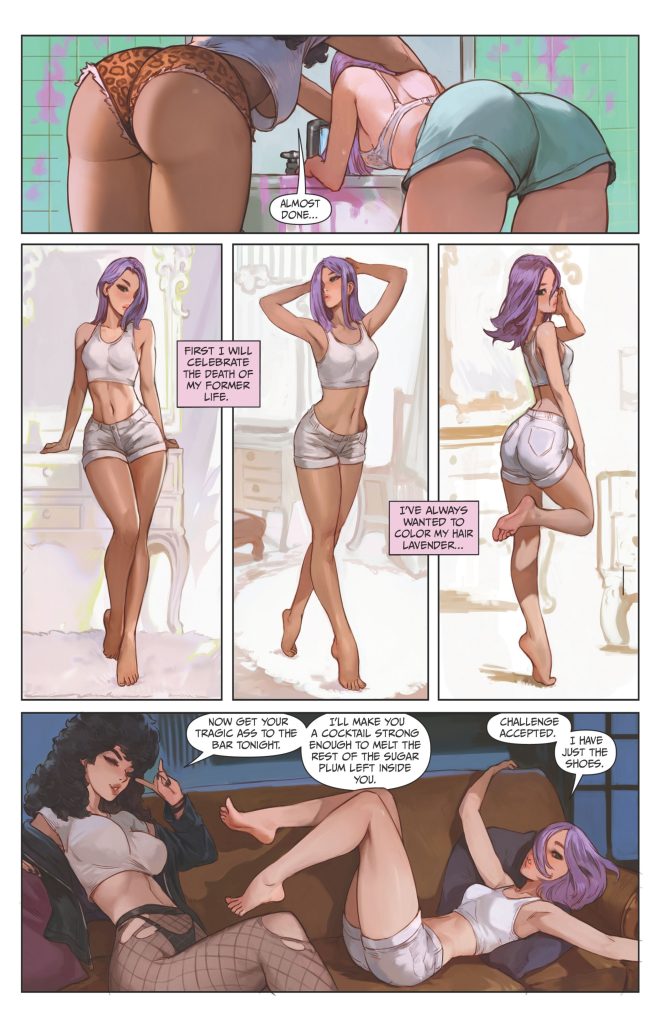
Filippo’s artwork is described as cinematic, saturated and dramatic. How do you balance the exploitation aesthetic with the story you’re actually trying to tell, and where’s the line, if there is one?
Tanita Ross-Cady: The line between exploitation and deeper messaging is always a blurry line. I purposefully chose panel images, angles, clothing aesthetics, and color palettes that would grab the reader’s primitive brain to force attention to the beautiful and sexually charged pages, but I spent a lot of time crafting a main character with relatable problems that most people can sympathize with. Combine this sexy imagery with raw dialogue that is poignant and emotional…
I think we are walking the line with grace. By the time the reader moves to the word balloons, I’ve worked to capture their biological attention first. It’s a physiologically effective way to create deep, layered psychological attachment to the main character. This is why I felt like it was important to begin the story with the main character bashing herself onto the floor and her career ending, we see the wound created in real time.
I needed to force the reader to feel empathy for the loss of Maeve’s former identity before I forced her to be reborn in the underground.
You run a podcast about the anomalous and otherworldly, you write poetry, you founded a media company, you were a circus performer — what is the through line in all of it, and where does Sole Mate sit in the larger project of whatever it is you’re building?
Tanita Ross-Cady: I’ve had a very peculiar life. When I was really really young, my parents told me that I had an imaginary friend who was an alien I named Farkley that I claimed followed me everywhere. I had my first paranormal experience when I was seven years old and they’ve continued my whole life. I started lucid dreaming when I was 14 years old after a traumatic experience forced me to figure out how to overcome night terrors.
Lucid dreaming allowed me to create a relationship with my subconscious that has given me the opportunity to go on Avatar the Last Airbender-level adventures in my sleep on a weekly basis. This makes the real world harder to take seriously. When I was 18 I began experimenting with astral projection, after a lot of practice I was able to get out of body and locate lost items and do experiments where I could see correct combinations of numbers in remote locations.
I didn’t understand it was psychokinesis at the time, but in my twenties I had emotional outbursts that resulted in electronics breaking or frying. I have witnessed things that most people believe only exist in sci-fi films. I’ve always been a part of these hidden worlds that the ordinary world keeps trying to convince me doesn’t exist. My life has been very scary and extremely magical. Writing has always been my greatest outlet to process all of this. Because I live like telekinesis Matilda on the other side, the whole “societal expectation” thing feels like a sad joke to me.
This is why I’ve lived a very untraditional life. This is why I’ve been so entrepreneurial. This is why I love the process of creative discovery. For me, it’s about exploring, not the destination. Does this feel good? Do I enjoy this? No? Move on. Yes? Explore. This is how my foot ended up in a stranger’s mouth on a bus. It was enthralling.
The anomalous experiences cracked open my brain at a very young age and made me want to passionately explore as much as possible, the fearlessness fueled my need for grand adventures. That intersection is where Sole Mate fits into all of this. I have rejected a normal life. I like stories where women reject the rules of society, where women lean into fear and the uncertainties of life and emerge stronger, smarter, and more clever.
I love stories where women use their talents to get what they want. I like lead characters who think outside of the shoebox and strap the heels on then head out into the night. Sole Mate isn’t esoteric like a lot of my other content, but it encompasses all the delicious creative risks I’ve ever taken rolled up to one.
Follow Tanita Ross-Cady on Social Media
Tanita Ross-Cady on Instagram>>
More in Comics