Previously on Super Mondo Mega Mutts
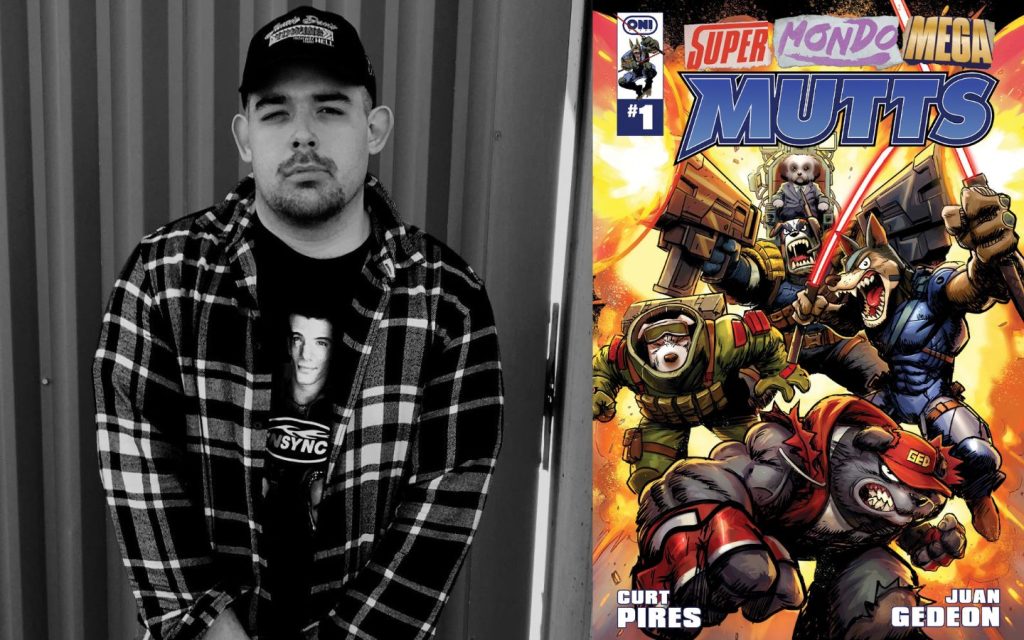
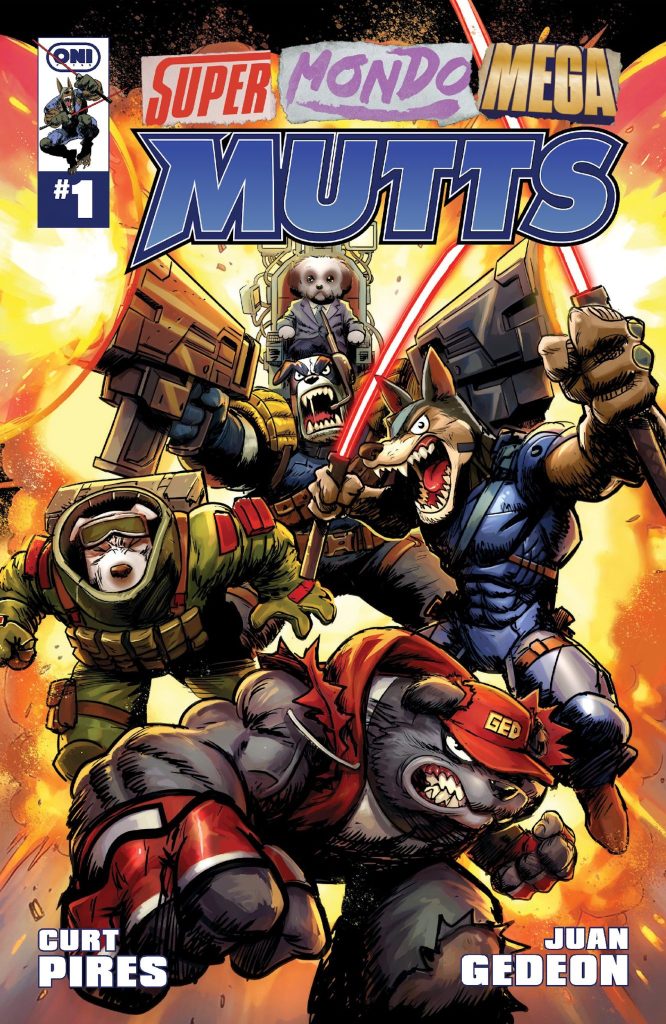
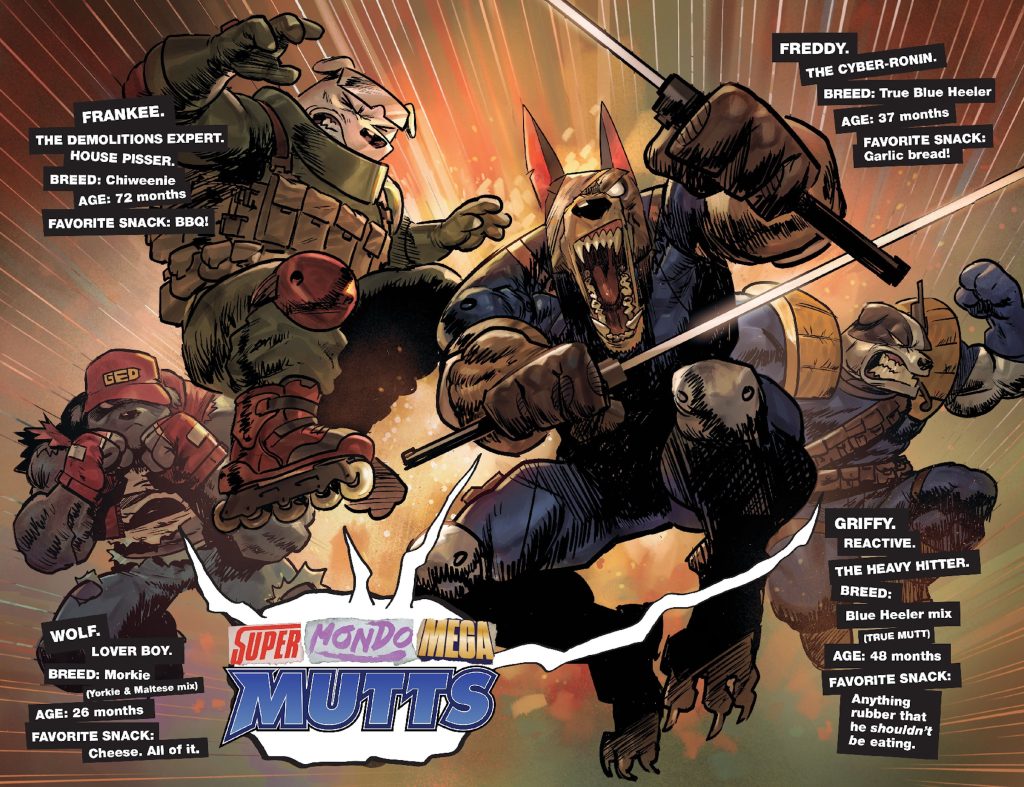
Curt Pires has a habit of calling his shots before the work hits shelves, and this time he’s not hedging. Super Mondo Mega Mutts is Pires’ new four-issue miniseries with artist Juan Gedeon. Launching from Oni Press with editor Karl Bollers at the helm, Super Mondo Mega Mutts follows four genetically engineered government dogs, armed to the teeth, loose in a Downtown L.A. built around an inter-dimensional rift called The Gleam, just trying to find their way back to something resembling a normal life.
It’s Kamandi with a dash of TMNT by way of We3, except Pires insists it isn’t the sad-animal book you’re bracing for. It’s the complete opposite. He’s calling it the first entry in a genre he just invented — the awesome animal book.
Issue one clocks in at forty pages, and Pires has already started talking about the series outliving its four-issue cover line. I caught up with him to talk about outlaw dogs with Liefeld-sized weapons, what he owes to Juan Gedeon’s art, and why he picked Oni — and Hunter Gorinson and Sierra Hahn specifically — to be the ones to launch it.
An Interview with Curt Pires about Super Mondo Mega Mutts
You’ve called this one of your best ideas ever — which is a hell of a thing to put on the record before issue one even hits stands. What’s the bar you’re setting for yourself with Super Mondo Mega Mutts that you weren’t setting on Lost Fantasy or Fireborn?
Curt Pires: I love all the books and think they’re great, but there’s a level of accessibility and insanity combined with SMMM that I think makes it one of my biggest ideas ever. You can show non-comic readers a page out of this book, with the dogs, and instantly get them curious. It’s such a splashy and interesting idea.
Karl Bollers name-checks Kamandi, TMNT, and We3 as the lineage. That’s a wide spread — Kirby’s pulp-cosmic sprawl, Eastman and Laird’s punk DIY ferocity, and Morrison’s three-issue gut-punch about military-experiment animals trying to go home. Which of those three is closest to the soul of this book, and which one are you most consciously trying not to repeat?
Curt Pires: There’s a bit of all of those in the book, but I’m really interested in making it its own thing. We live in the era of the sad animal book – and while there are sad and poignant moments in this, it’s not a sad animal book. It’s sort of the opposite. It’s an awesome animal book. I’m making a new genre.
RELATED: An Interview with ‘The First Vixen’ Creator: Aria Taheri
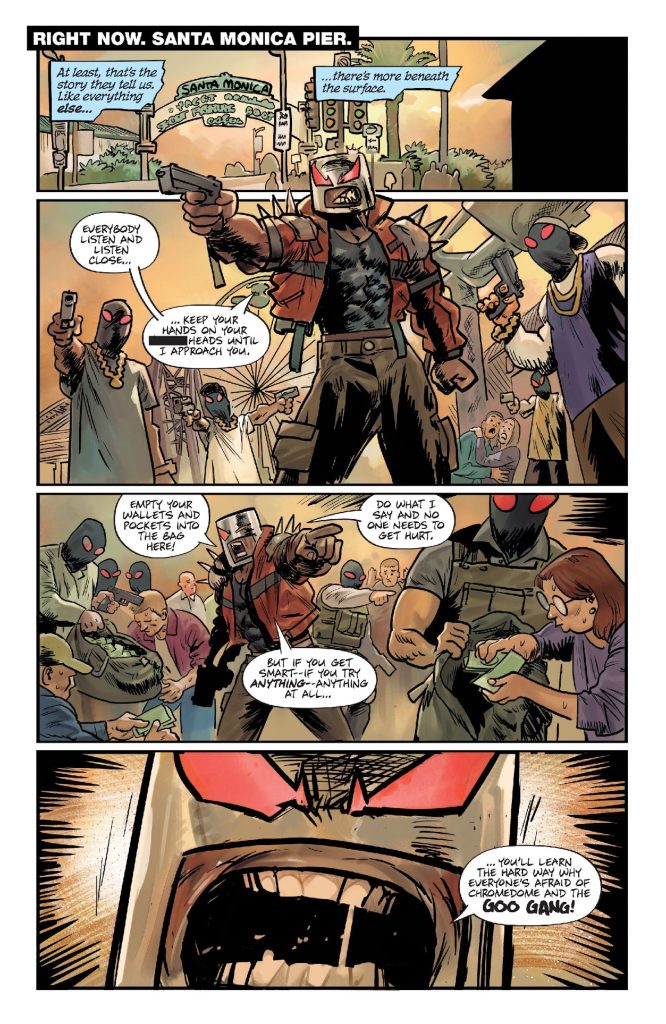
“The Gleam” is a beautiful piece of nomenclature — vague, threatening, a little wondrous. How much of the inter-dimensional terrain inside it have you already mapped out, and how much is going to reveal itself as you write into it?
Curt Pires: I have a complete idea of what it is in my head, but the mystery is part of the fun. We’ll get a deeper dive and exploration of it in issue three, as our boys figure out what exactly is going on and who is behind it.
You’ve described the dogs as “outlaw misfits” the government tried to put on a leash. That’s a politically loaded setup in 2026 — federal forces operating with impunity, contractors weaponising whatever they can get their hands on, gangs with stolen tech filling the vacuum. How heavy do you want the political subtext to land, and where do you draw the line between commentary and sermon?
Curt Pires: I’m never interested in sermonising in my books. Least of all in the book where the dogs have giant Rob Liefeld weapons. At the same time, I’m not afraid to set the book against a political backdrop. It’s a fine line, but at the end of the day, It’s about exploring and asking questions rather than lecturing my audience. Other writers can annoy people with that behaviour, it’s not for me.
The first issue is double-sized at forty pages, which is a real statement of intent in a market where most #1s are racing to get readers in and out in twenty-two. What does that extra real estate let you do that a standard-sized debut couldn’t, and how did you decide what belonged in the opener versus what to hold back?
Curt Pires: I love a giant sized first issue — that makes the book feel like an event rather than just another issue. It’s a big chance to suck people in, and again, I think this is a killer first issue. I tried to jam as much awesome as I could into the 40 pages, and there was still stuff I had to condense. I think comics need to be bursting with coolness and fun from staple to staple, so that was really the goal.
RELATED: THE O.Z. is back on Kickstarter, and it’s bringing the war Home to Oz one last time
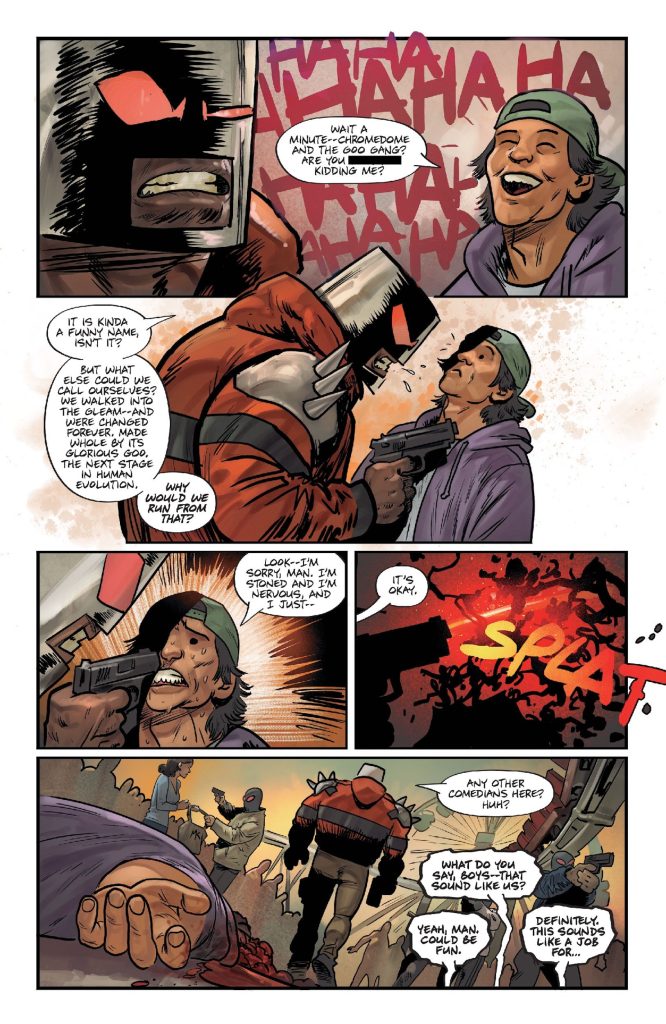
The Gleam sits at the centre of Downtown L.A., which is a real place with real residents and a very specific cultural texture. How much of actual L.A. — the geography, the gentrification, the politics, the smell of the place — bleeds into the worldbuilding, and how much is pure invention?
Curt Pires: This element and the crisis element was inspired by observing how crazy Los Angeles gets in any sort of crisis. The fires, Covid… it’s often a powder keg, so it felt interesting to explore. Also, I’ve spent a lot of time in LA, love the city, and it’s fun to have it as a backdrop.
Editor Karl Bollers says at the core this comic is about four dogs who just want a normal life. That’s a quietly devastating sentence underneath all the bombast. How much of the book is action and spectacle, and how much is actually about loss — about animals who can never go back to being what they were?
Curt Pires: The dogs want a normal life and to find their owners again. Find their homes. But at the same time, this is about the journey, not the destination. A story where the dogs find their way home fast — it’s just not interesting. They’ve got faces to punch and a city to save first.
You and Juan have collaborated before, but this feels like a step up in scale and ambition. What does Juan bring to this material that another artist couldn’t, and how does the way you write the script change when you know it’s his hand on the other end of the page?
Curt Pires: Juan is the Norman Rockwell of steroidal animals. There’s no one else who could bring the dogs or the action in the book to life. We’re collaborating very closely and everything is fluid.
RELATED: An Interview with ‘Voltessa: Masquerade of the Macabre’ Creator: Justin Gray
It’s a four-issue miniseries on the cover, but books like Lost Fantasy have a way of growing once readers latch on. Is Super Mondo Mega Mutts a closed-loop story you’ve already plotted to its ending, or is the ending elastic depending on how the world responds?
Curt Pires: It’s going to be much bigger than four issues, I think. We have to earn our readership by doing great work and marketing the book, but everyone involved sees this as a massive idea with a bright future.
Oni Press has been on a serious creative tear under Hunter Gorinson and Sierra Hahn — you’ve publicly noted as much. What is it about the current Oni specifically that made it the right home for this book, as opposed to keeping it creator-owned somewhere else or shopping it to one of the bigger players?
Curt Pires: Oni is on a tear right now curating a great line of books and pushing them hard into the market. I think what attracted me to ONI is the fact that besides having great taste, both Hunter and Sierra are folks who love comics and treat comic creators well. They’re not IP bandits with venture capital money looking to own the next great idea. They love the medium and want to see comic creators, comic shops and the medium thrive, which are the same goals I have.
Thanks for your time!
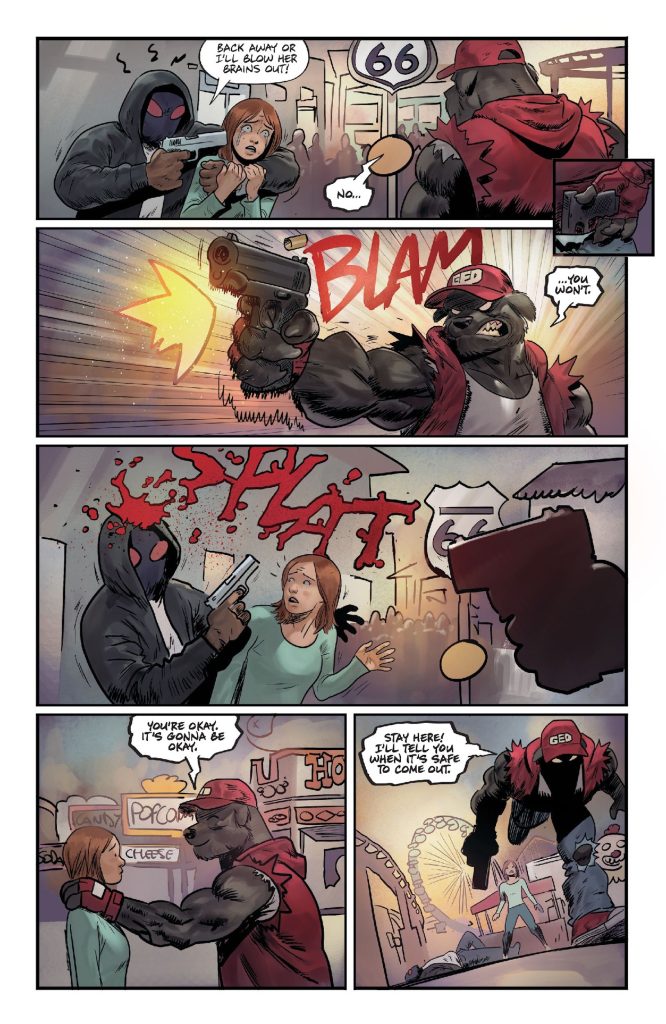
More Super Mondo Mega Mutts Preview Pages
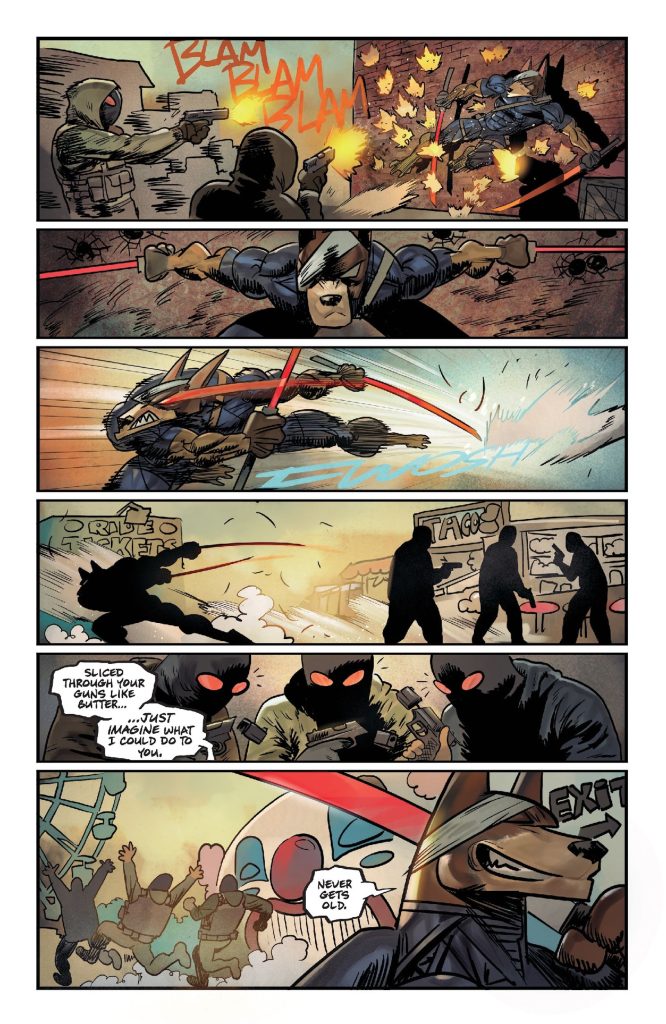
Will you be picking up a copy of Super Mondo Mega Mutts?
Did this Curt Pires interview convince you to pick up an issue of Super Mondo Mega Mutts? What’s your favourite comic book series featuring animals as the chief protagonists?
Let me know in the comments.
More in Comics, Interviews