
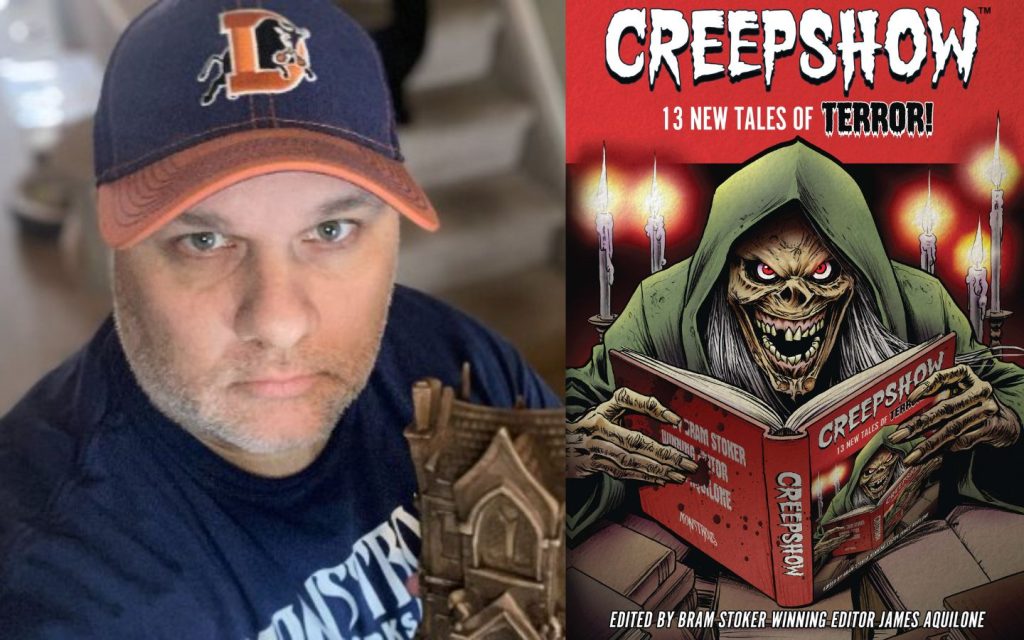
Previously on Creepshow
James Aquilone has built Monstrous Press into one of the most exciting names in genre fiction – having raised over half a million dollars through Kickstarter on projects spanning classic monsters, cult TV, and pulp horror. Now he’s taking his biggest swing yet: a fully licensed prose anthology set in the world of Creepshow, the beloved horror franchise that began with the 1982 George Romero–Stephen King film and has since spawned sequels, comics, and Greg Nicotero’s acclaimed Shudder series.
Creepshow: 13 Tales of Terror arrives June 23, 2026, in three formats, and it marks the first time the franchise has been translated into a prose collection.
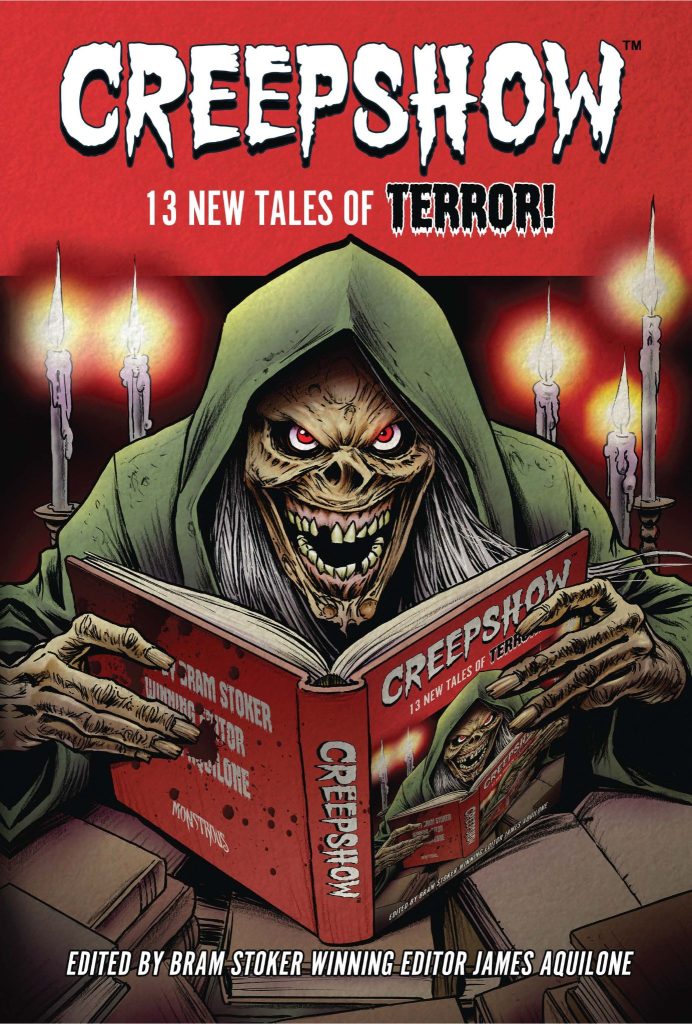
Aquilone edited the volume, assembled a roster of contributors, and wrote one of the thirteen stories himself — a haunted house tale with a twist he’d been sitting on for years. The book leans into everything that made Creepshow so iconic: the EC Comics morality plays, the gallows humor, the cosmic consequences, and The Creep himself, introduced in full-page illustrations by EV Cantada for every story.
I caught up with Aquilone to talk about unlocking the Creepshow format, wrangling the franchise’s non-negotiables, and what he wants lifelong fans to feel when they close the back cover. Thankfully, no one died during this interview.
An Interview with James Aquilone about Creepshow: 13 Tales of Terror
Creepshow has been around since 1982 — film, sequels, comics, and Greg Nicotero’s Shudder run — and yet somehow nobody’s done a prose collection until now. What was the unlocking idea that made you go, “okay, this is how it works on the page”?
James Aquilone: Creepshow’s tales are almost always adapted from short stories, so the DNA was already there. The unlocking idea was realizing we didn’t need to imitate the pacing of the films shot-for-shot; we could lean into what prose does best while still honoring the comic-book horror tone and the morality-play structure that defines Creepshow.
The Creep is basically Creepshow’s Crypt Keeper, and so much of his menace comes from that wordless, leering visual. How do you smuggle that energy onto a page where readers can’t actually see him grinning at them?
James Aquilone: Each story is introduced by The Creep with a full-page illustration by EV Cantada, so readers absolutely will get to see him grinning at them. Beyond that, the narration and framing aim to capture his gleeful, sardonic presence — the feeling that he’s leaning over your shoulder enjoying every bad decision the characters make.
The franchise has always been about cosmic karma — bad people, worse endings. How tightly did you hold the contributors to that morality-play DNA, and did anyone hand in something that broke the formula in a way you didn’t see coming?
James Aquilone: That morality-play DNA was important, but we didn’t want every story to feel mechanically identical. Writers had room to surprise us, and a few stories definitely bend expectations in fun ways while still feeling unmistakably Creepshow.
Thirteen stories instead of the classic five-segment structure is a real choice. What does prose let you do with the Creepshow format that the films and the show physically couldn’t?
James Aquilone: Prose lets you get inside the characters’ heads. In film and TV, you rely on performance, editing, and visuals. In fiction, you can explore paranoia, guilt, obsession, and self-deception directly. That psychological layer opens up kinds of horror that are harder to sustain on screen.
Licensed properties always come with a rulebook. What was non-negotiable from Evoke’s side, and where did you find the most room to push?
James Aquilone: The big non-negotiable was that the book had to feel authentically Creepshow — the tone, the dark humor, the sense of cosmic comeuppance, and The Creep’s presence all mattered. Within that framework, we had a lot of freedom in setting, characters, and the kinds of nightmares the writers wanted to explore.
You’ve got Russ Braun on the cover and EV Cantada doing a full-page Creep illustration for every story. That’s a lot of art for a prose collection. Was that always the plan, or did the book want to be a Creepshow artifact more than a regular anthology?
James Aquilone: I love including illustrations in prose books, especially horror collections. Creepshow has always lived at the intersection of comics and cinema, so the art wasn’t decoration — it was part of making the book feel like a proper Creepshow artifact.
When you brought writers in, did you hand them a list of Creepshow-flavored prompts to riff on, or just turn them loose and trust them to bring the Creep to whatever they were already cooking up?
James Aquilone: There was a brief bible, but it wasn’t something writers had to follow rigidly. We wanted the stories to align with the existing Creepshow universe and tone, but we also trusted the contributors to bring their own voices and obsessions to the material.
RELATED: An Interview with ‘Hell of a Job’ Writer: Dave Franchini
You contributed your own story to the book on top of editing it. What’s yours about, and what was the idea you couldn’t not write once you had the keys to this universe?
James Aquilone: My story is called “Tiny House (of Terror).” It’s an idea I’d wanted to write for a long time, and this project finally gave it the perfect home. All haunted house stories take place in large, sprawling homes. I wanted to see if I could write a haunted house story that took place in one that wasn’t so long. I’ll let the readers decide if I pulled it off.
Monstrous is basically a Kickstarter institution at this point — Classic Monsters Unleashed, Kolchak, Omega Eleven. So why is Creepshow the one that goes straight to retail instead of through your usual crowdfunding playbook?
James Aquilone: With a major licensed property like Creepshow, the goal was broad retail reach from day one. We wanted fans to be able to walk into a bookstore, comic shop, or online retailer and find it immediately.
Half a million dollars on Kickstarter over four years is no small number. How has that changed the kind of swings Monstrous can take now versus when you started?
James Aquilone: It’s allowed us to take much bigger swings creatively and commercially. We can pursue larger licenses, commission more ambitious artwork, and produce books at a higher level of quality than we could when we were starting out.
Striker Entertainment brokered the deal. Walk me through the actual journey — when did the first conversation happen, and how long has this book been quietly in the works?
James Aquilone: The deal came together surprisingly quickly. We started talking about it roughly a year ago, and once everyone realized the idea made sense, the project moved forward fast.
Horror anthologies are having a moment right now. Where do you see 13 Tales of Terror sitting on that shelf, and what’s the thing it does that the others don’t?
James Aquilone: A lot of anthologies are excellent showcases for horror fiction. This one brings the Creepshow identity with it — the comic-book framing, the gallows humor, the cosmic punishment, and, of course, The Creep himself.
The book hits June 23, 2026, in three formats. Anything else cooking — special editions, audio, follow-up volumes if the Creep ends up wanting more?
James Aquilone: If The Creep wants more, we’ll do more. I’ll have to consult with him first.
For the diehards who can quote the ’82 film line for line — what’s the one feeling you want them sitting with when they close the back cover?
James Aquilone: I want them to feel like they just found another forbidden issue of the old Creepshow comic — entertained, unsettled, and maybe a little guilty for how much fun they had watching terrible people get exactly what was coming to them.
Do you have a personal connection to Creepshow? Where does your fan story start and how did it evolve over time?
James Aquilone: I grew up on horror anthologies, EC Comics, and the Romero/King style of horror storytelling, so Creepshow was always in my orbit. What’s changed over time is appreciating how precise the balance is between humor, horror, and morality.
One question I like to close my interviews with is what’s something you’ve been enjoying lately — whether it’s a book, comic, album or movie?
James Aquilone: I’ve been revisiting classic horror anthologies and EC-style comics lately, which probably isn’t a surprise. A new hardcover collection of Tower of Shadows, a horror/fantasy anthology comic book originally published by Marvel in the 1970s, is something horror fans should definitely check out.
Thanks for your time.
James Aquilone: Thank you! Always happy to talk horror, comics, and Creepshow.
Will you be picking up a copy of Creepshow: 13 Tales of Terror?
Did this James Aquilone interview convince you to pick up an issue of Creepshow: 13 Tales of Terror?
More Stuff on Soda and Telepaths
- An Interview with the Creator of ‘Urbance’ : Joël Dos Reis Viegas
- An Interview with Cover Artist Howie Noel about the ‘Dick Tracy: 1961-1964’ Collection
- The Adult Performer Defying Expectations: An Interview with Lady LorReign
- An Interview with the Creators of ‘Fort Psycho’: Matt Kindt and Brian Hurtt