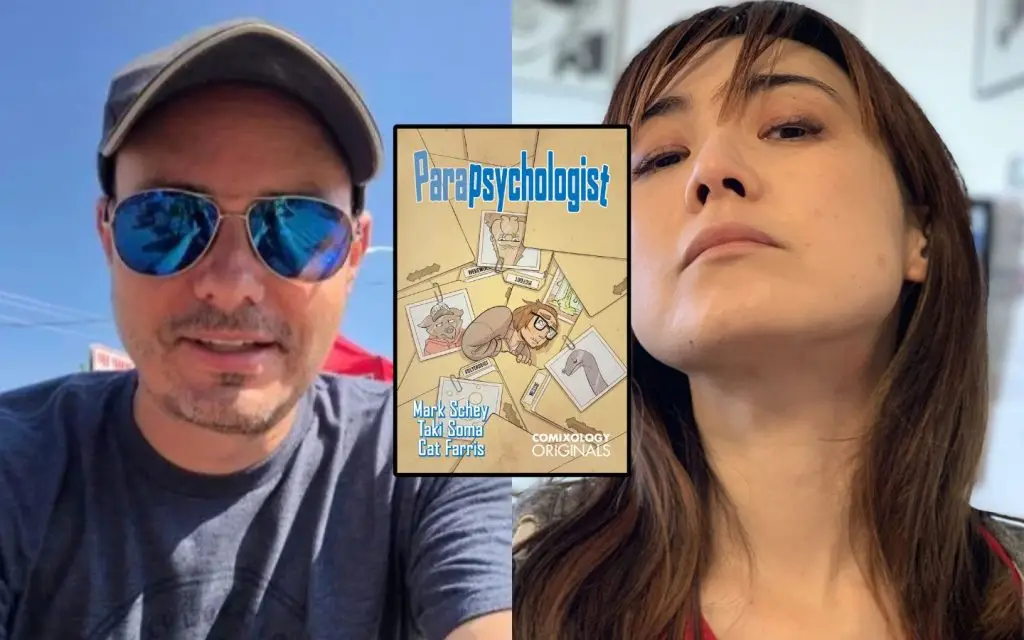
Previously on… Parapsychologist
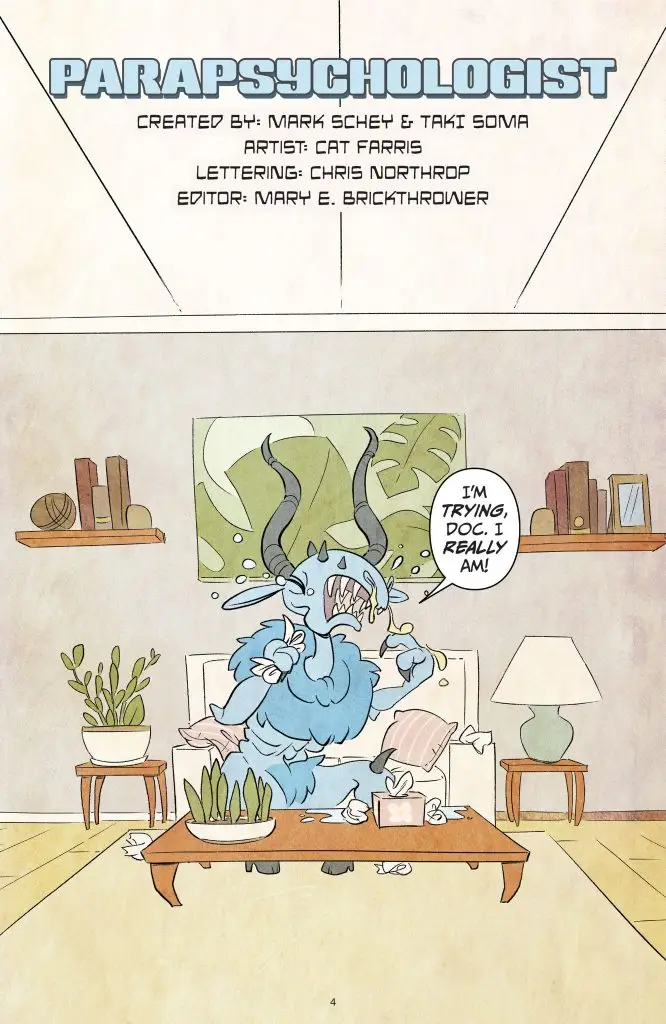
Parapsychologist begins with a deceptively simple, slightly absurd premise – a therapist treating supernatural patients – but quickly reveals itself as something more personal and emotionally grounded. What started as a spontaneous title between collaborators Taki Soma and Mark Schey evolved into a story where monsters aren’t just metaphors, but fully realised characters dealing with very human struggles. Beneath the humour – werewolves with hypochondria, poltergeists with agoraphobia – the book explores mental health with sincerity, using the paranormal as a lens rather than a punchline.
Created during a difficult period in both creators’ lives, the graphic novel balances comedy with genuine emotional weight. Soma and Schey consciously avoid making the conditions themselves the joke, instead using humour as a way to process and connect. The result is a genre-bending mix of family drama, mystery, and absurdity that aims to make readers feel seen – whether through laughter, discomfort, or recognition.
In this interview, I sat down with Taki and Mark to discuss Parapsychologist in finer detail. A graphic novel following a therapist treating supernatural patients which blends personal mental health experiences with comedy to help readers feel less alone in their struggles.
An Interview with Taki Soma and Mark Schey
Parapsychologist feels like it came from somewhere pretty specific – a therapist whose patients just happen to be supernatural beings. Where did the original spark come from, and how did it evolve from “wouldn’t it be funny if…” to a full graphic novel?
Taki Soma: It absolutely came from something very specific. Mark Schey, the co-creator/co-writer and I were racking our brains trying to find a new project to work on together after our successful and fun experience co-writing two stories together for an anthology called Black Box Chronicles. We were exploring all sorts of subjects and genres, and we landed on something that’s existential and super weird, and based on a real story about a sci-fi writer… but then Mark at one point blurted ‘Parapsychologist’ and the rest is history, as they say. The title says everything and that’s a rare occurrence. I do think it’s funny that it came from a serious concept we were cooking up to what ended up as a comedy. But that’s creativity at its best, especially doing it with a friend.
Mark Schey: That’s my process. I blurt out a title, and then everyone has to deal with it.
Taki, you’ve talked openly about your own experience with psychotherapy. At what point did the personal stuff start bleeding into the fictional stuff – and were you ever tempted to pull back from how honest it gets?
Taki Soma: The personal stuff bleeds into all my fictional stories. I mean, haven’t you gone into your therapy session as a werewolf or poltergeist? … wait, my therapists all had the same look on their face when I say stuff like that. Hmm… so, you see, I don’t hold back. The sessions are almost word-for-word. Except for pages 2-19, 22-126 if my memory serves me correctly. Also, if we pull back, it is to be sensitive about these hard subjects and the psychological challenges we tackled in the pages are ones either myself or Mark have experienced personally. Oof, I think I need a lot more therapy still…
Mark, you described working on this book during some of the hardest years of your lives. That’s a big thing to put out there. Do you think the difficulty of that period is visible in the finished work, or did the comedy end up being a kind of shield?
Mark Schey: I don’t think you can write anything honest without your life bleeding into it. It’s not directly reflected in Parapsychologist, but the emotions of that period are absolutely in the book. Comedy seemed like a good place to put it. If people want the less disguised version, that’s probably closer to my short in the A1 Deadline revival called “Self-Aware in AISLE 5.”
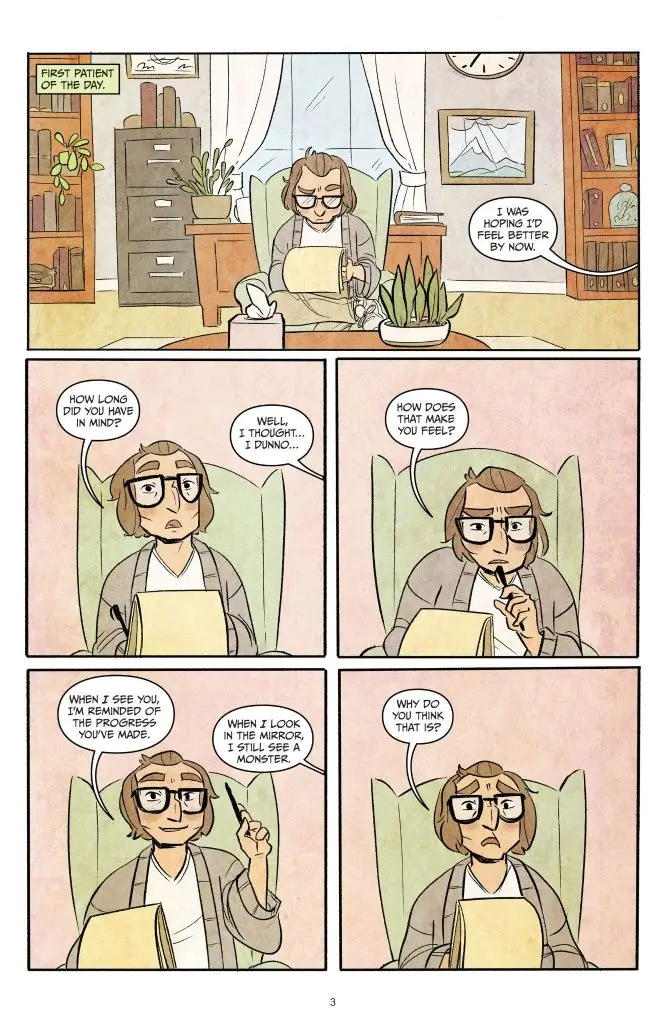
Dr. Ron Richards treats poltergeists with agoraphobia and werewolves dealing with toxic masculinity. How did you decide which paranormal beings got which human issues – was there a logic to it, or was it more instinctive?
Taki Soma: Both. We didn’t want to be on-the-nose unless it was ironic or comical. The fact that Werewolf has hypochondria when society depicts them as an alpha-male is paradoxical. We asked ourselves why an entity would ‘haunt’ a home, to us, it makes sense that they suffer from agoraphobia – because they won’t leave. All the creatures offer metaphors of our worst fears and conditions; it was fun to explore them all. Also fun fact, hypochondria and agoraphobia were both conditions I have suffered in the past!
Mark Schey: Yeah, we wanted the creatures to feel like people, not just delivery systems for obvious monster jokes. If every issue was, “Look, a vampire is afraid to go to church”… actually, that one might work. Maybe he was a priest before he was bitten. But in general, it was much more fun to take iconic creatures and stick them in therapy.
There’s a long tradition of using monsters as metaphor in comics – but Parapsychologist sounds like it’s doing something a little different, treating the paranormal stuff almost literally rather than symbolically. How conscious was that choice?
TS: The monsters and creatures in Parapsychologist are people to us. They have bills, families, insecurities (obviously!) and whatnot. They can’t help it that they’re supernatural. When you look at them that way, they become more than their metaphors that gave them life in the first place. They have layers. They have goals. They have issues.
MS: There’s probably a version of this story where everyone’s human, and it still works. But that would be far less fun. Part of the appeal for me was treating the supernatural like it’s just another layer of ordinary life. Paranormal creatures. They’re just like us!
Taki, your previous work spans everything from Bitch Planet to Dick Tracy to your autobiographical Sleeping While Standing. Where does Parapsychologist sit for you in terms of what it cost you creatively and emotionally to make?
TS: That’s a loaded question. But to sum it up, it was a lesson in trust. I’ve come to enjoy work that’s mostly under my control – but to have a co-creator to consider and an artist who won’t let me even color her work (and rightfully so, she’s so much better than I am) was a challenge to me. But a challenge I learned from and am proud of. Now, if you ask the rest of the team, I picture them rolling their eyes at me. I tried, guys, I really did!!
Cat Farris’s art on The Ghoul Next Door already proved she can walk the line between cosy and creepy. What made her the right collaborator for this particular book – what does she bring to it that you couldn’t have gotten anywhere else?
TS: I’ve known Cat casually for a long time. We live in the same town, or to be precise, neighboring towns and share similar social circles here. Portland, Oregon is teeming with cartoonists, really. If you don’t live here, move here immediately. Anyway, I’ve always admired Cat’s work, but I really like her a person, too. I wasn’t sure what the book looked like, but when Cat’s name came up when we were scouring for an artist, it just clicked. We almost had no notes as she turned in her pages too. I think it was kismet that brought her onto Parapsychologist for this reason.
MS: I come from TV and commercial directing and one of my favorite terms is “score on sight.” We’re mixing horror creatures with comedy and family, which is strange, so the reader needs to understand the tone immediately. Cat’s art does that. It tells you instantly what kind of world you’re in and how to feel. She was perfect for this book, not just because of how awesome she is, but because she also knows the setting. She added so many fun, authentic details.
The book is described as a comedic family drama and a mystery – which is already a lot of plates spinning. Was there ever a version of this story that leaned harder into one of those elements at the expense of the others?
TS: The family drama wasn’t the main focus at the start, you’re right. But the more we wrote, the more it merged with one of our own experiences and it didn’t feel authentic to omit what felt sincere to us. There is one storyline that warms my heart a lot and I hope it brings tears to the readers. Yes, tears. Muhaha.
MS: Hah! This sounds suspiciously like you’ve seen an early draft. We went back and forth on that a lot. Early on, I was drifting toward an X-Files/Buffy structure, with a monster of the week underneath the family story. You know, a dysfunctional Scooby gang chasing a cursed artifact in the B-story. I was basically building a pilot. Taki kept pulling it back toward the family story and she was right. But, I’ll be honest, the episodic itch is still there. Maybe in the next book, if we get one.
The villain of the piece is a former patient who comes back to destroy Ron’s life and practice. Without giving too much away – what kind of threat are we talking about here? Are we in “unsettling slow burn” territory or “absolute chaos” territory?
TS: The “no matter what you do, we’re all doomed” level. It’s real evil stuff. I can’t stop them. I’m sorry.
MS: So doomed that calling it “comedy family drama” becomes irresponsible.
Mental health in comics is a subject that can go very right or very wrong very quickly. What were your red lines going in – things you absolutely weren’t willing to do with the material?
TS: We agreed we explore conditions we were at least familiar with and better if they’re issues that we’ve personally dealt with. We were very conscious about the sensitivities surrounding mental health. I hope we succeeded.
MS: The red line was simple: the condition isn’t the joke. The humor could come from anywhere else, but not from mocking the struggle itself. I had pretty bad anxiety as a teenager, and I vividly remember reading a book that described exactly the way it felt. Someone else knew! So I’m a big proponent of putting it out there. Ideally, people see parts of themselves in the book and feel recognized.
Taki, you mentioned wanting to break a taboo and make readers feel less alone in their pain. That’s a genuinely ambitious goal for what’s also being sold as a comedy. Do you think humour is underrated as a vehicle for that kind of connection?
TS: Absolutely. Humor is the reason I’m alive today. Without it, I would’ve never recovered from the many conditions I’ve suffered. Life is a joke, in the best way. Seriousness cannot exist without humor. Of course, humor isn’t the only thing in existence, but it is an integral part of the human experience.
Mark, you also co-created Black Box Chronicles and worked on the 2025 Deadline UK reboot – you clearly gravitate toward ambitious, character-driven genre work. What does Parapsychologist give you as a writer that those other projects didn’t?
MS: Comedy. I think I’m funny but I’ve gravitated to darker material. Sci-fi, horror, dystopian stuff. So the challenge wasn’t learning to be funny, but getting comfortable putting it out there. Something more absurd, but still grounded enough to hurt a little. I liked that balancing act.
ComiXology Originals as a home – how did that come about, and does the digital-first format change anything about how you think about pacing, page turns, or the reading experience?
TS: All of it were considered while writing Parapsychologist. I really thought about pacing, and how the digital experience might differ from print. I thought about how it would print when we were writing for digital-first comic, too. The team at Comixology was really helpful with all of that though, so it was an easy transition. I would love to work with them again – and that should tell you why it ended up there. No notes!
The receptionist character sounds like they’re going to be crucial to the back half of the story. Can you tell us anything about who they are and why that dynamic with Ron matters?
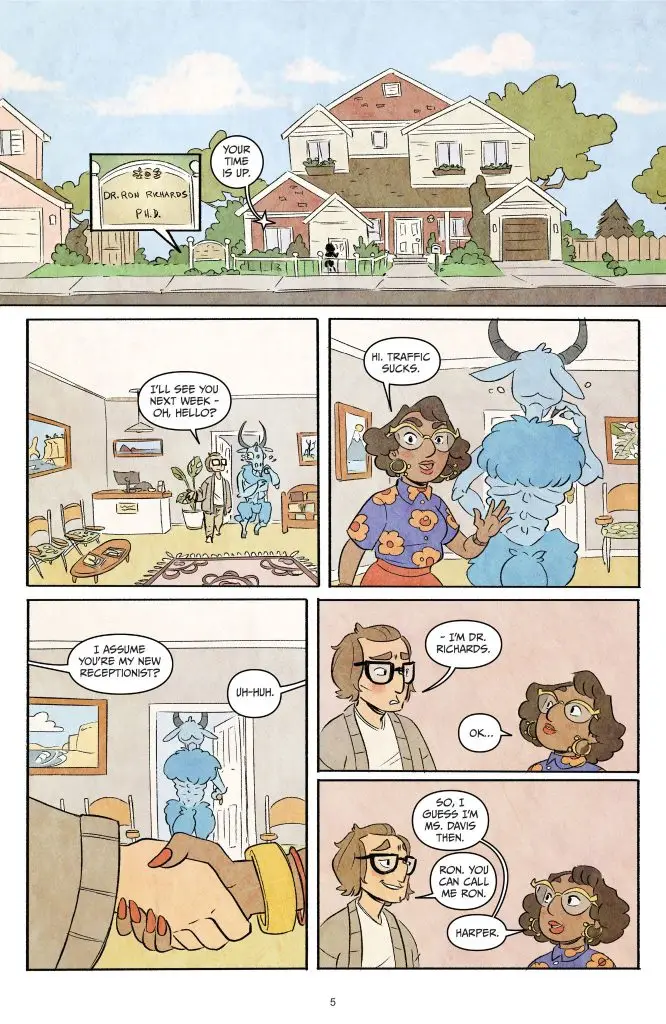
TS: Harper. She’s the entry-point character to introduce the reader into the world of Parapsychologist. Because her first day at work is where the story starts, we get to experience the world through her lens. If she reads this, please tell her she has purpose beyond it and that she has her own storyline. (I’m a little bit scared of her.)
MS: I love that Harper is new, but she’s not innocent. She walks into this absurd situation and immediately reads the room.
If Parapsychologist finds its audience and people connect with it the way you’re hoping – what does that look like? What’s the version of this where it worked?
TS: Total and complete dominance of the universe.
MS: More books, more terrible cases for Ron, a TV series that runs long enough to get weird and all the actors have music careers. Then, one day I’m at a convention, and somebody I’ve never met is dressed as Barb or Werewolf. After that, yes, total dominance of the universe.
Thanks for taking the time!
TS: Thank you so much for this interview!!! I appreciate you.
MS: Yes, thank you! I appreciate the thoughtful questions.
Pick up a copy of Parapsychologist on Comixology or Kindle.
More in Comics, Comedy, Comixology, Horror