Previously on… Fort Psycho
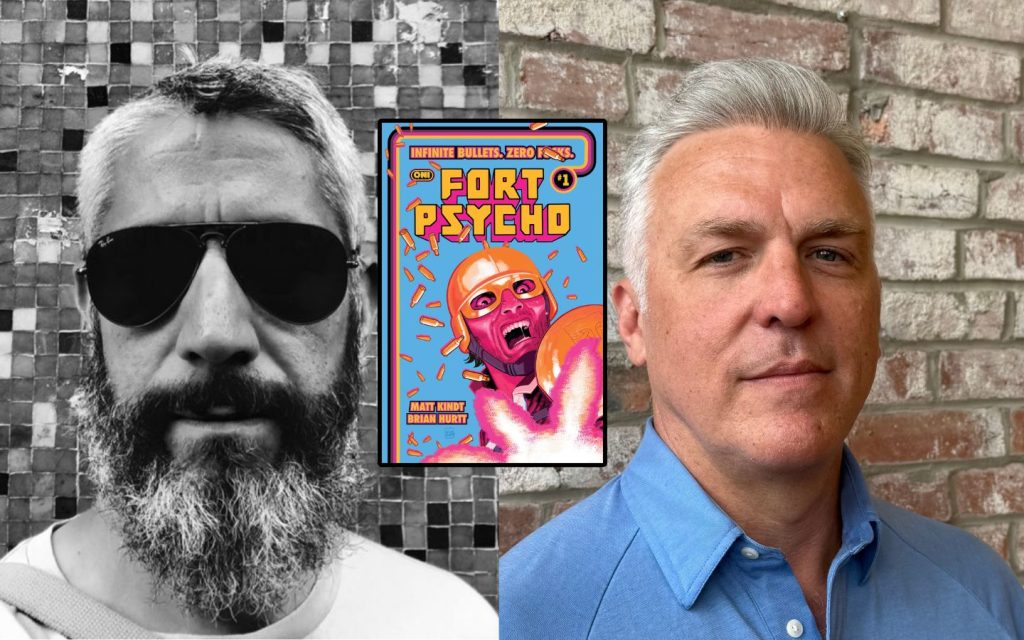
Matt Kindt and Brian Hurtt have spent years dismantling genre expectations — and with Fort Psycho, they’re doing it again. The twelve-issue maxi-series takes the colorful, codename-driven world of classic military action comics and pulls back the curtain, asking harder questions about loyalty, identity, and who we’re actually rooting for.
With a sunken Singapore, a prison island full of disgraced operatives, and a mole hunt at its heart, it’s a book with serious ambition wearing a very cool disguise. I sat down with both creators to talk archetypes, action choreography, and why knowing your ending is the only way to begin.
An Interview with Matt Kindt and Brian Hurtt
You’ve described Fort Psycho as deconstructing GI Joe archetypes the way Watchmen deconstructed the Charlton heroes. Which specific archetype in the book do you think will surprise readers most once they see how you’ve torn it apart?
Matt Kindt: Reading G.I. Joe as a kid – the biggest mystery for me was the identity of Cobra Commander. He’s the big bad – so who is he and what is his story? But I grew up and that answer never came… or if it did, it came after I’d outgrown those comics. So for me, what was interesting was to explore that idea. It’s not so much about the good guys versus bad guys – even though that’s in here – but it’s really about who’s the bad guy? And why? What’s the motivation? And are we rooting for the right people/person? So we’re trying to do that without losing the fun of what makes it all exciting to read. Cool gadgets and gear and colorful characters and costumes.
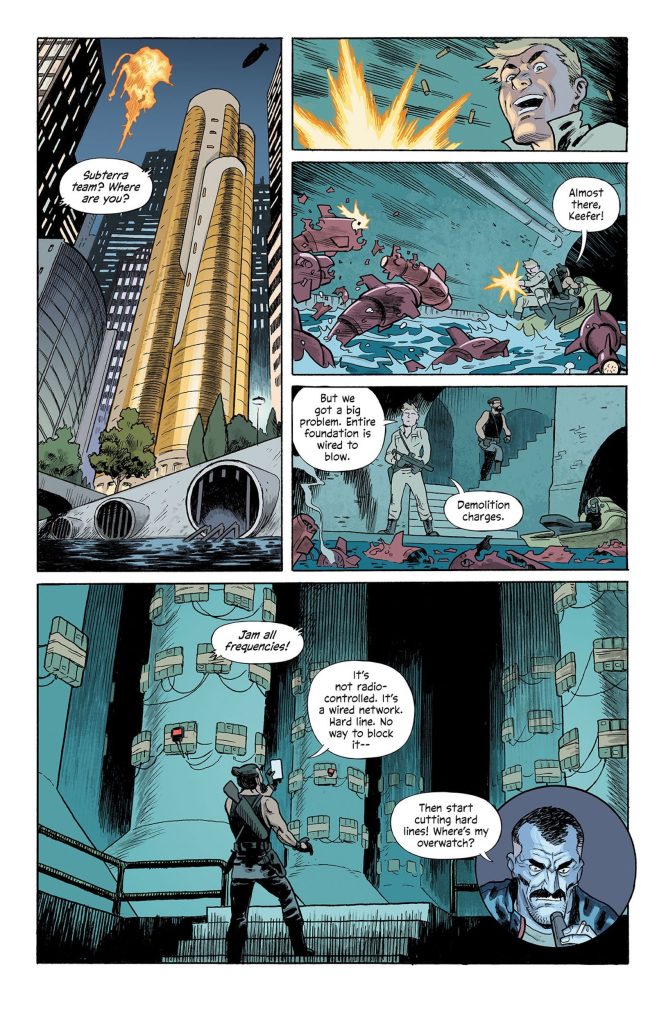
Brian Hurtt: If I had to pick one archetype in particular it would be the grizzled, war-hardened leader of the outfit. In our series, that is a character named Keefer and it’s been fun to slowly unwind the expectations you might have of a character like this and reveal a much more complicated set of qualities and motivations.
Singapore sinking into the Pacific is a wild opening premise – it immediately raises the stakes to a global scale. How did you land on that as the inciting event, and how do you keep something that enormous from overshadowing the human stories at the center?
Matt Kindt: Well, that as the “inciting event” is actually the concluding event. It’s the disaster that happens that shuts down Fort Psycho and gets all of its agents put on a prison island. We start the story at the end… with everyone treated as war criminals and then the story fills in some of the past and how we got here while trying to figure out who the big-bad guy is… and is he one of the prisoners now on the island? It’s a real mole hunt.
Brian Hurtt: An ongoing theme of the book is the characters world-trotting, operatic missions juxtaposed against the base humanity of these individuals. Stripped of the costumes and the world-saving exploits, who are these people? Everyone is a hero in their own eyes and the stories they tell themselves come under the microscope over the course of the 12 issues.
RELATED: An Interview with the Creators of ‘Ancestral Recall’: Jordan Clark and Atagun Ilhan
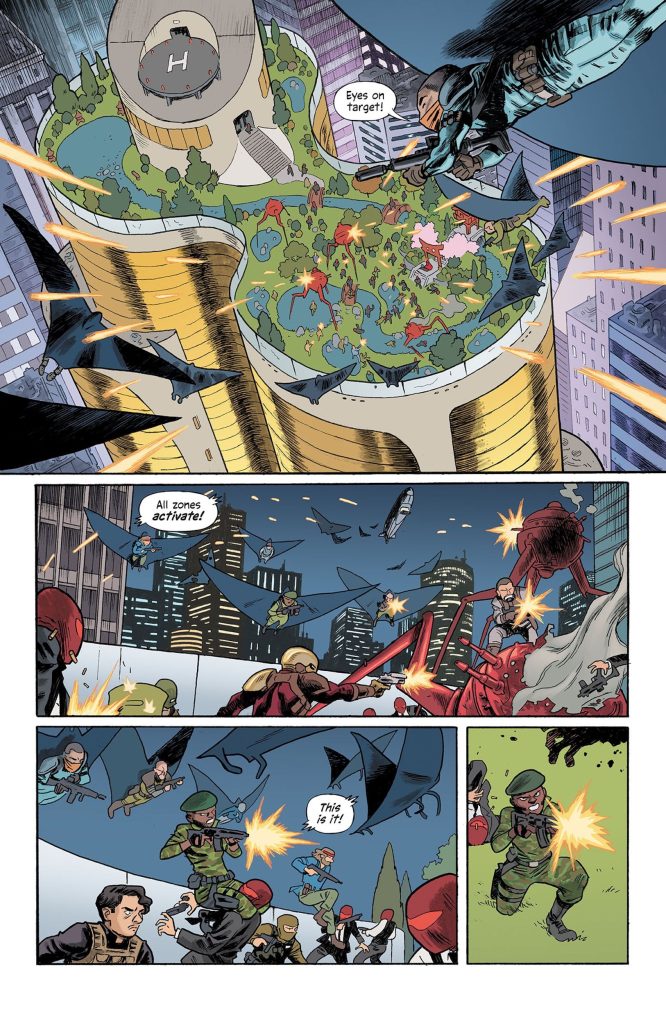
Fort Psycho is a 12-issue maxi-series with a clear endpoint. How does knowing the finish line affect the way you’re plotting and pacing the story?
Matt Kindt: I’ve never written a story where I didn’t have the ending figured out. A very detailed outline goes a long way. You can’t seed ideas and moments into the first few issues if you don’t know what the seeds are going to grow into. We have it broken down into three big acts, 4 issues each, all building to a final issue that we both talk about all the time – we can’t wait to get to a few certain moments.
Brian Hurtt: It’s a massive benefit to know where you’re going. Like Matt said, it allows you to plant seeds – in both story and in visuals – that are paid off later. I can design scenes and panels that mirror one another and place Easter eggs that can pay off to the sharp-eyed reader later. It all makes for more substantive world-building and allows a story to have roots.
Matt, ‘Fort Psycho’ and Mind MGMT are launching just two months apart this summer. Are there any thematic threads that connect them, or are they genuinely two completely separate headspaces for you?
MK: Yeah – they’re very different. I think they attack a lot of the same themes but with very different tools. One uses guns and bombs and the other one is using brains.
Brian, your work on ‘The Sixth Gun’ has a grounded, Western-gothic feel. ‘Fort Psycho’ sounds like a completely different energy – high-octane action, island prisons, globe-spanning chaos. How are you approaching the visual language of this book differently?
BH: I don’t think of these two titles too differently from an art point of view. In most ways, the subject matter or the genre changes but the camera does not. If that makes sense? There are subtle things in my art that the two series might differentiate on though.
Sixth Gun definitely had a gothic horror vibe to it that expressed itself in more use of shadows and spooky lighting. But that language also seeps into Fort Psycho. I’ll say that Fort Psycho definitely has more speed lines and sharper, more manga-inspired, kinetic action than Sixth Gun did and that’s been a lot of fun to explore.
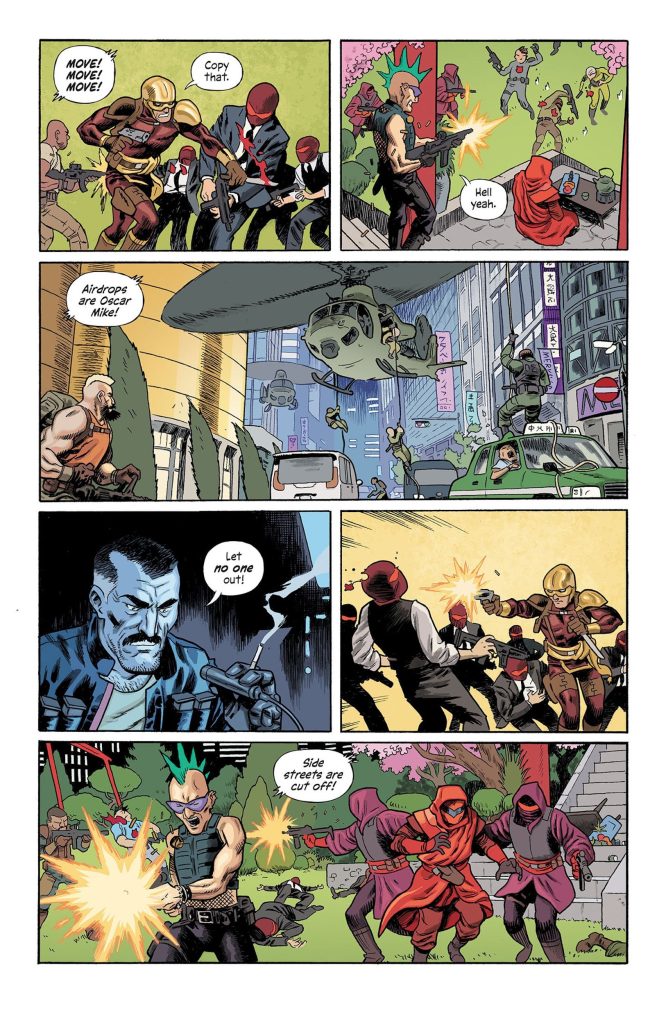
Matt, you’re introducing a large cast of new characters – Shiv, Lycan, and Dragonfly are already named. How do you build distinct, memorable personalities for a dozen trained killers without letting them blur together?
MK: We have a big shared document with tons of character names and bios and we cross them off as they get killed. It’s probably the most fun part – coming up with the different personalities and skills and traits. We had a lot of fun with the names – even Bill Crabtree (the colorist) has been texting us a bunch of codename ideas.
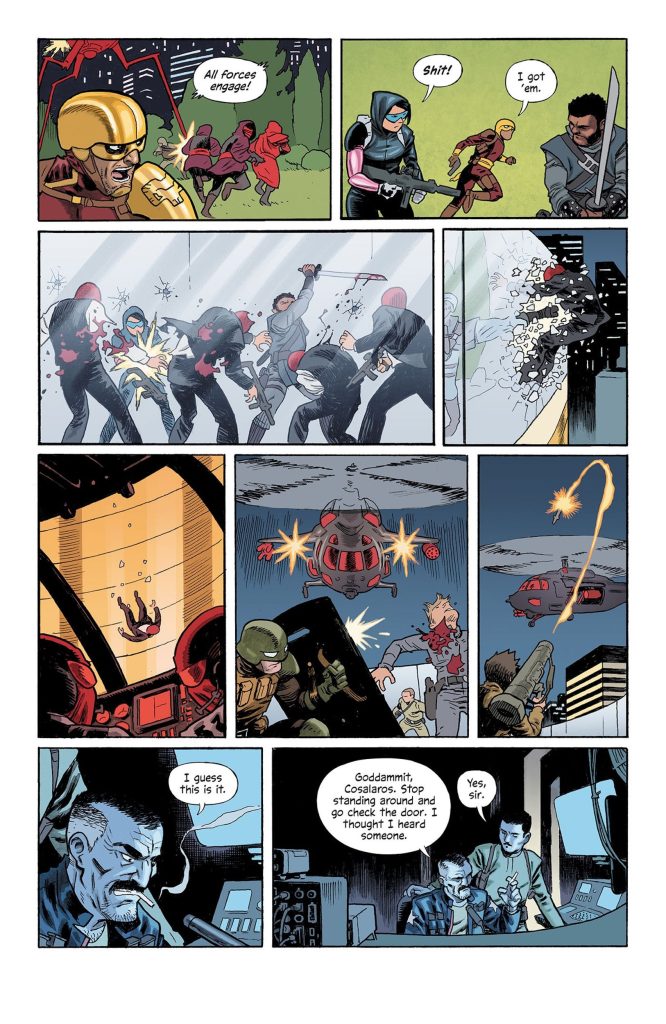
Brian, action comics live and die by clarity in their choreography. What’s your process for making sure a reader can follow the chaos of a firefight panel by panel without losing the thread?
BH: The touchstone in any action scene is, as you said, “clarity.” I really spend a lot of time focused on making action sequences clear and easy to follow while at the same time keeping them dynamic. I once had someone describe it as “organized chaos” and I tend to view it the same way. There is always a lot going on, but the action that is key to the story should always be forward and clear to follow to the reader.
Bill (Crabtree, colorist), is also key to establishing the throughline and the storytelling through color choices. Choreographing these scenes on the page is one of my favorite things to do in comics and I put a lot of pressure on myself to make them work!
Matt, the FCBD special doubles as a preview ofMind MGMT: New & Improved. How are you managing two major launches so close together – do the projects feed each other creatively, or do you have to keep them compartmentalised?
MK: They’re separate but really, are they? Fort Psycho is really a psi-ops monthly comic funded by Mind MGMT. I think what Mind MGMT is doing is just a little too subtle so it helps to have a comic book that tells a story while wearing a mask and kicking in doors.
RELATED: Pulp Babes & Adult Comics: An Interview with Penerotic
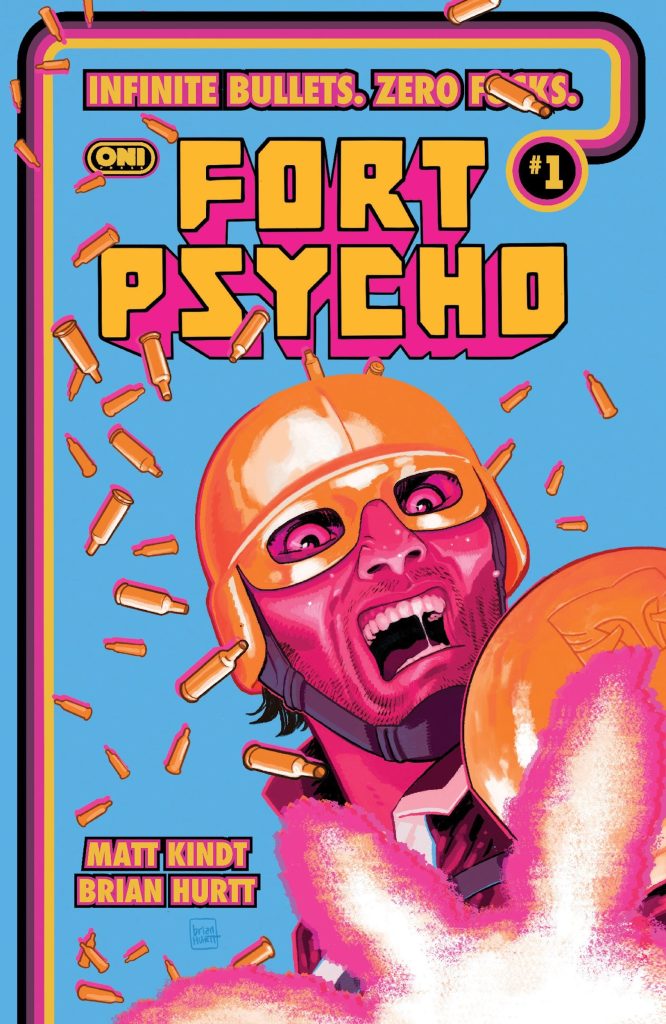
Brian, you’re doing covers as well as interior art for the series. How do you think about the cover as its own design challenge versus the storytelling work happening inside the book?
BH: The covers are a whole different beast than the interiors! I love doing them but in many ways they’re more challenging. I live and breathe sequential art but this kind of “poster art” is something I do less often and involves a whole different set of problems to solve. When doing covers my goal is two-fold.
First, try to create a cover that stands out – in a sea of comics – from a design and color point of view. And secondly, try to create an image that is compelling or evocative. You want someone to look at the cover and feel compelled to pick up the book because they want to know more.
You’ve both got your own personal accolades when it comes to comic book canon, but I’m curious how you think ‘Fort Psycho’ differs to what you’ve done before?
MK: It’s really the venn diagram of things we love in comics. G.I. Joe, spies, cool gear and gadgets, fun codenames, romance, and action with a little bit of thought behind it. It has a point to it but is going about things in a fun and entertaining way.
BH: For me, it’s more adult in its themes and interpersonal dynamics than other books I’ve worked on. In many ways, even with the theatricality of the costumes and gear, it’s more grounded than the genre books I’ve done in the past.
If you could only take one GI Joe character into a firefight with you – who would it be and why?
BH: The Cobra characters were always my favorite but I’ll split the difference and say Storm Shadow. An obvious choice but he was always my favorite. He was the most fleshed out character in the old comics and he’s a total badass. Give the man a gun, a sword, a bow and arrow and he’s a killing machine. Take them all away and he’s left with the ultimate weapon – himself!
MK: Scarlet. She’s the smartest and has a super-cool crossbow.
One question I like to use to close out my interviews on a positive note. What’s something that both of you have been enjoying lately – whether it’s a book, comic, album or movie?
MK: I just finished reading James M. Cain’s novel Double Indemnity. It’s one of my favorite movies and I’d just never gotten around to the book. It’s maybe 120 pages and there’s not a wasted word in it. In the original Mind MGMT series Salvador Dali directed a sequel to Double Indemnity called Triple Indemnity so I think I was reading the book in preparation for Mind MGMT: New & Improved because Mind MGMT is working on a prequel to Double Indemnity called… “Single Indemnity.”
BH: In comics, I like anything that Simon Roy does and I just recently read his new collection A Star Called the Sun. He’s a master world-builder and the best sci-fi writer in comics. And I’m looking forward to reading The Court Charade – a new book with art by the French art duo Kerascoet. Their book Beautiful Darkness is one of my all-time favorite graphic novels.
I’m also currently loving DTF St. Louis on HBO. It’s written and directed by Steve Conrad who several years ago created one of my favorite shows, the criminally overlooked Patriot. And I think it’s safe to say that the latter show is influential to both Matt and I on Fort Psycho.
Thanks – both of you – for your time. It’s been a pleasure.
Have you read Fort Psycho?
Will you be picking up this action-packed maxi-series?
Thanks for reading.