Previously on… Urbance
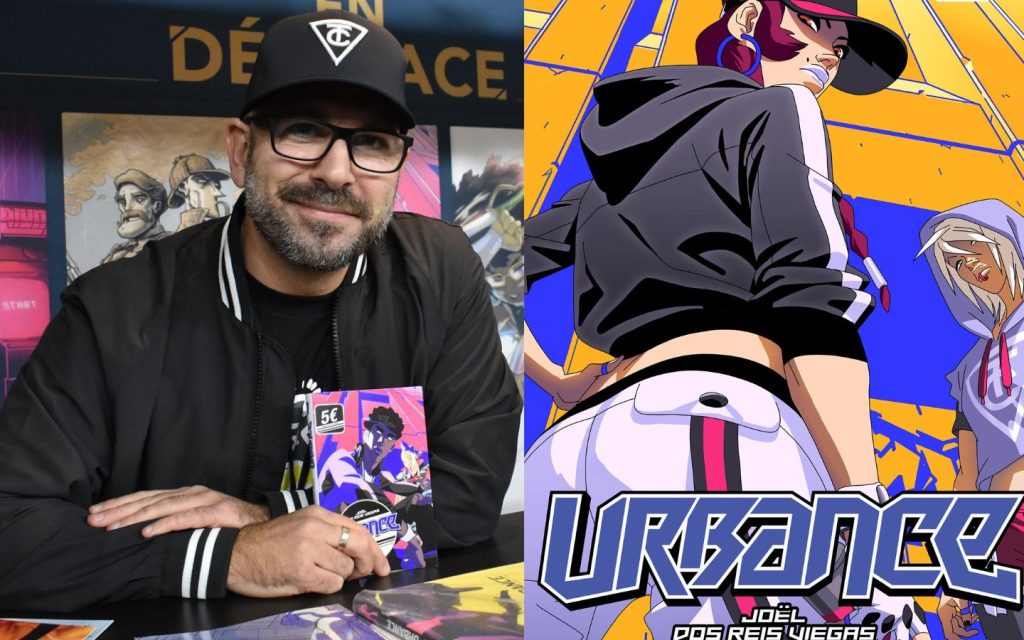
Joël Dos Reis Viegas has spent his career building other people’s worlds. From the rain-slicked streets of Gotham in Batman: Arkham Origins, to the monster-scale destruction of Godzilla, and let’s not forget the neon swagger of Black Dynamite. He’s frighteningly good at what he does. But somewhere between a meeting that went nowhere with a Django Unchained producer and a Japanese animation studio letting a Frenchman rediscover his own characters through someone else’s brush, Viegas started building something no one could greenlight away from him.
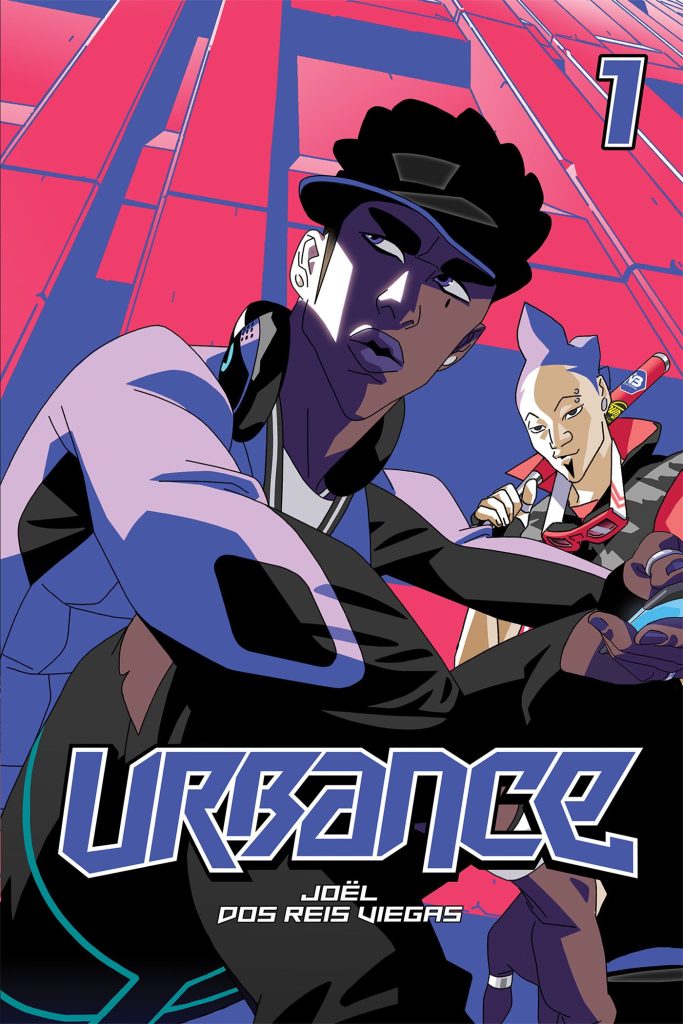
URBANCE began as a fever dream with a one-pager and a 90-second teaser. It became an animated short and now, after years, it’s arriving as an 828-page graphic novel saga — a bio-punk Romeo & Juliet, if you will. Set in a neon-drenched city called Neopolis, where a mysterious virus has made physical desire between men and women instantly fatal, a wall splits the city in two, and an underground drug called N-Dorphin is about to blow the whole fragile arrangement apart.
Coming to Kickstarter through Oni Press and Magnetic Press, I sat down with Viegas to talk about division, LSD, a humbling lesson from a Princess Mononoke animator, and why the world he imagined in 2011 refuses to stop being relevant.
An Interview with Joël Dos Reis Viegas
You told Hollywood producers about URBANCE back around 2013 and admitted you weren’t ready — no script, no synopsis, just the vision. Looking back, do you think that meeting happening too early was actually the thing that eventually forced URBANCE to become a comic?
Joël Dos Reis Viegas: You’re right, I had the opportunity to meet Reginald Hudlin in Los Angeles back when he had just finished producing Django Unchained. He said he was struck by my 90-second teaser and invited me to meet him, even though I had nothing concrete but a one-pager storyline. He was expecting more, and obviously, our discussion ended there… When I headed back to Montreal with my head full of ideas, I started writing and 2 years later, my partners and I produced the animated pilot you all saw.
In a way, this slap in the face pushed me to go even deeper in writing and most importantly, keep the ownership of my ideas. This is the reason I’ve decided to turn Urbance into a graphic novel series, to really tell the story I wanna tell!
The press release describes Neopolis as a city where physical desire is literally deadly. That’s a hell of a premise. Where did that core idea come from — was it political, personal, or did it just arrive fully-formed one day like a fever dream?
Joël Dos Reis Viegas: I’d say all the ideas came to me naturally. The core theme of Urbance has always been Division. I wanted to tell the story of teenagers raised to hate one another, so I needed a valid reason to instigate that hatred and fear. As I was sketching out my two heroes, the resemblance to Romeo and Juliet became obvious: young people forbidden from living out their love. That gave me the idea to create this HIV-like virus that prohibits any physical contact, and then the idea of the wall to justify that division.
You’ve talked about choosing a more aggressive visual treatment for the comics. But 828 pages is a long time to sustain a tone. Are there pages in the later volumes where you let the darkness breathe — where it gets quieter, or stranger — in a way the pilot never could?
Joël Dos Reis Viegas: Yes, even though I’d generally categorize my work as dark or dystopian, there are moments of levity. Specifically in volumes 2 and 3, where we follow Kenzell and Lesya—without spoiling anything—during more intimate moments as they get to know each other, isolated and far from danger. In my storytelling, there are always two viewpoints that the reader constantly jumps between, which keeps the narrative dynamic.
The atmosphere might feel tense among the girls while the boys are partying, and vice versa. I like to take the reader on an emotional rollercoaster, while never forgetting that my story is, above all else, a manhunt.
RELATED: An Interview with the Creator of ‘Halloween Boy’ : Dave Baker
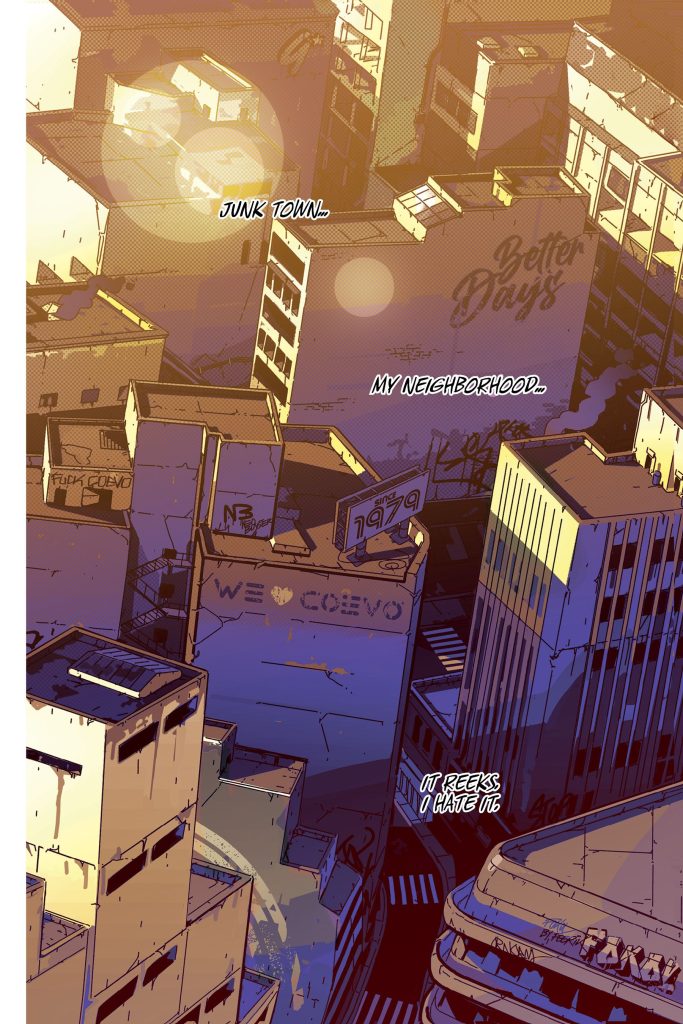
You’re now Art Director at Yellow Brick Games while simultaneously finishing an 828-page graphic novel saga. That’s an insane double life. Does holding down a full-time games career actually protect URBANCE somehow — keep it from becoming just a job?
JDRV: That’s an excellent question, and I’d never really looked at it from that angle. To me, Urbance has never been a ‘job,’ yet it represents so much work and sacrifice! Having a full-time job allowed me the time to develop my universe and find my artistic voice without financial pressure. I took advantage of that to rewrite everything, rethink the entire project from scratch, and launch this comic book series.
I’ve learned a lot from the team at Ankama, my French publisher; they truly helped me grow into my identity as an author. Looking back, it was perhaps a blessing that I didn’t know how much work it would take!
What’s your preferred type of cyberpunk? Something like ‘The Matrix’ which is clean and immaculate or something like ‘Tetsuo: The Iron Man’ which is gritty and accentuates body horror as a deconstruction of art?
JDRV: Hard choice! I love these references and I’m torn. I’d say my heart goes to Tsukamoto’s work, but my head leans toward Neo and Trinity, likely due to my artistic upbringing. However, what I can say without giving too much away is that Otomo continues to influence me, time and time again, as the pages turn. [winks]
The animated pilot has this incredibly slick visual identity that made people lose their minds when they first saw it. Robert Valley called it “damn slick.” LeSean Thomas compared it to Fat Albert, The Boondocks, and Black Dynamite. How do you carry that visual DNA into a black-and-white comic format without losing what made it electric?
JDRV: My goodness, you’re putting the pressure on! Ahaha, it’s true that Robert and LeSean had such kind words. I can’t thank them enough! Beyond the acid and neon colors of the pilot, I’d say what makes my art and universe stand out are the exaggerated anatomy of my characters, my love for fashion, and my use of perspective. For the comic, I refined my character designs and chose a fast-paced, cinematic layout — almost like if I was making the black-and-white version of the Urbance animated series.
RELATED: An Interview with the Creator of ‘PALOMINO’ : Stephan Franck
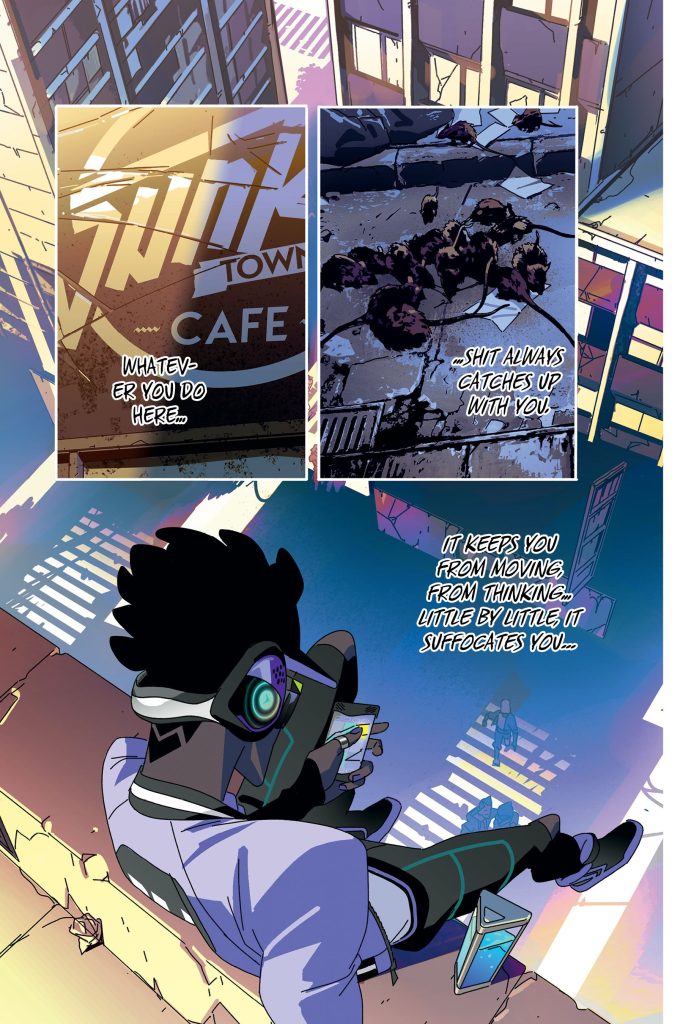
Kenzell and Lesya are your Romeo and Juliet — kids shaped by a world designed to keep them apart. How do you make sure they feel like teenagers and not just symbols? What gives them their specific humanity?
JDRV: To me, they are ordinary teenagers in every sense of the word. With their zest for life, their desires, their frustrations, and their weaknesses. Throughout the story, they make choices that are sometimes strange or risky, leading them down a difficult path, yet they remain true to their convictions. I think what makes Kenzell and Lesya unique are their flaws: Kenzell is carefree and extroverted, while Lesya is guarded and introverted.
They embody the very division I wanted to illustrate — a duality in their personalities — yet they share the same longing for freedom. They are, in my view, a more modern and less cliché couple than Romeo and Juliet.
Neopolis has a very specific relationship between fashion and survival — what you wear signals which side of the wall you’re from, and getting it wrong is dangerous. As someone who grew up between Paris and Montreal, two cities with very different street cultures, was there a specific moment or place where you understood that clothes could be a weapon?
JDRV: I like to think that our clothes define us and tell a story about who we are. In any case, if you understand how to adapt your outfit, you can change how others perceive you. I wanted to play with these codes in my comic, shifting between grunge, punk, and hip-hop, but also through the tattoos that the clans wear in my universe. These worlds don’t always mesh well together, which can spark friction — at least in my story!
N-Dorphin — an underground drug that might let you survive the thing you’re not supposed to feel. That’s a brilliant narrative device. Were you thinking about anything in the real world when you invented it, or was it purely a worldbuilding mechanism?
JDRV: I’d say both; I love the idea of mixing sexual desire with drugs, but also of having a strong narrative element to generate tension between men and women. N-Dorphin creates a false sense of balance and temporary joy in Neopolis, right up until the moment it becomes everyone’s object of desire. The status quo is shattered, and that’s where the story truly begins — it’s perfect for a B-story. And for the record, I was inspired by the LSD blotters I used to take when I was younger…
RELATED: An Interview with the Creators of ‘Fort Psycho’: Matt Kindt and Brian Hurtt
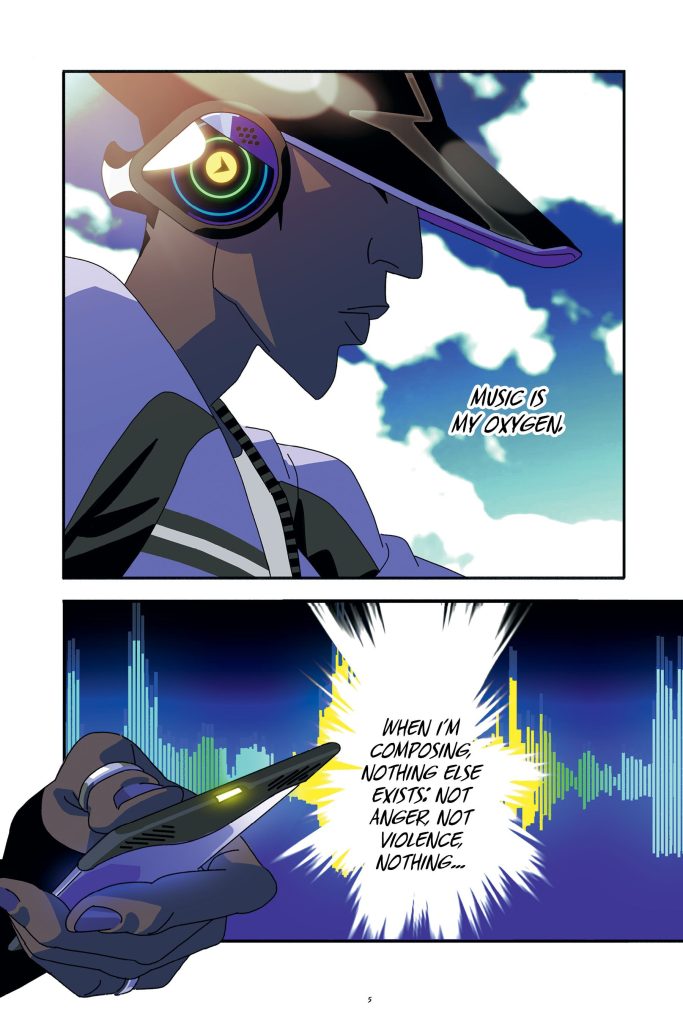
The series is described as a reflection of your “passions, your art style, and your fears.” That last word is interesting — what are you actually afraid of, and how does URBANCE express that?
JDRV: I’ll return to the main theme: division. The world is more fractured today than ever, and that was already the case in 2011 when I first imagined Urbance. The rejection of the ‘other,’ hatred, and social distancing are at the very heart of my story — as are control and enslavement through technology and entertainment (Coevo). In many ways, Urbance remains timely and reflects many of our shared fears.
Steambot and Yapiko Animation collaborated on the pilot back in 2015. What did that East-West creative exchange teach you about how different creative cultures approach something like URBANCE — a story that sits at a very specific intersection of Western and Eastern aesthetic influences?
JDRV: Working with a Japanese animation studio was a dream come true. I learned a true lesson in humility the day I saw Hiroshi Shimizu-san (Porco Rosso, Mononoke) redraw Lesya in his own style. That day, I literally rediscovered my own universe, and it changed my drawing style forever. Now, I pay more attention to my characters’ expressions, placing curves in just the right spots, trying to breathe more life into them.
Obviously, I can only speak from my limited experience on the pilot, but Japanese animators are accustomed to working with Westerners. I believe the biggest mistake is trying to tell them what to do; you have to let them take ownership of our worlds. It was in that spirit that we created the pilot together.
You’re bringing the full URBANCE saga to English-language readers through Oni Press and Magnetic Press — two publishers with serious indie credibility. What made this the right partnership for this project?
JDRV: I was lucky enough to meet Mike Kennedy at the Angoulême Comics Festival in 2024. We were introduced by Ankama, and at the time, we had only published the first volume of the series. Mike showed me the impressive work he had done on other French books adapted into English — by the way, all the best French authors are published by Magnetic Press.
I have rarely seen such attention to detail, and once I learned that Magnetic Press distributed Sergio Toppi, my favorite author, I was sold! When Mike announced in 2025 that he was partnering with ONI Press, it motivated me to finish the series even faster.
The Kickstarter for URBANCE includes a 10th Anniversary edition of the Genesis of URBANCE production art book. For readers coming to this world completely fresh, what does that book reveal about the project that the comic series itself doesn’t?
JDRV: It’s simple: this book covers all the preliminary work from 2011 to 2015. It includes all my early research, unused designs, keyframes, illustrations, and my narrative reflections on the world of Neo City (formerly Neopolis), as well as my collaboration with my friend and insolently talented artist, Florent Auguy. In short, it’s a blueprint of the project that says a lot about me, and I wanted to offer it to new readers to come full circle!
RELATED: An Interview with the creators of ‘Parapsychologist’: Taki Soma and Mark Schey
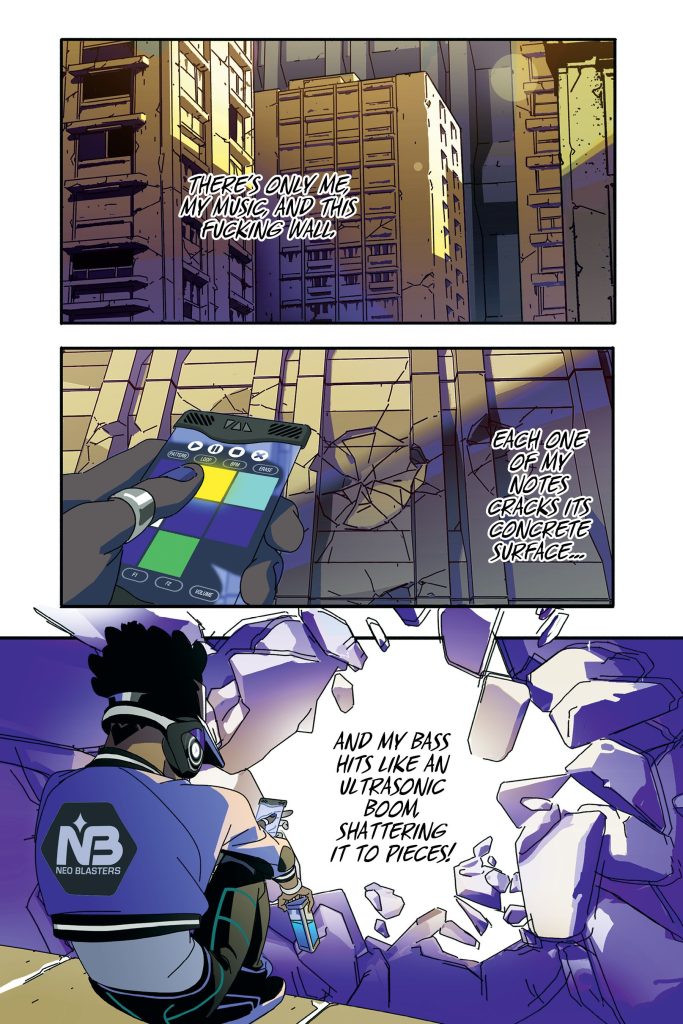
Gobelins trained you as an animator, not a cartoonist. Comics and animation are completely different disciplines — different relationship to time, movement, the reader’s eye. What did you have to actively unlearn from your animation brain to make URBANCE work as a graphic novel?
JDRV: That’s a very interesting question. What I learned from making animation is the fluidity of posing. It has been incredibly helpful for the comic, especially when playing with exaggerated perspectives. On the other hand, what I had to learn was how to synthesize; in animation, you break down every movement, but when you storyboard a full action sequence on a single page, you have to combine elements and get straight to the point.
I’ve learned not to state what I’m already showing through the art, and conversely, not to draw what is already being said in the dialogue. Show, don’t tell.
The theme of division — a literal wall cutting a city in two, entire youth cultures growing up in isolation from each other — feels very now, even though you’ve been working on this for years. Does that resonate with you, or does it make you a little uncomfortable?
JDRV: It doesn’t make me uncomfortable, but I’d say it saddens me that it’s still so relevant. Whether it’s the Berlin Wall, the one separating Palestine and Israel, or even closer to home in Mexico—division seems to be a part of human history. Far be it from me to play politics, but if I can oppose it through my work, then all the better.
What do you want a reader who has never heard of URBANCE to feel about ten pages in? Not think. Feel.
JDRV: Frustration and tension first, then combativeness, resilience and hope. Yeah, that would be amazing.
Thanks for your time.
JDRV: All the pleasure is mine!
What did you think of this Interview?
Will you be supporting Urbance? Let us know on social media.
More in Comics, Cyberpunk, Kickstarter