Previously on… Halloween Boy
There’s a particular kind of comics creator who doesn’t just love the medium — they’re haunted by it. Haunted by Fletcher Hanks. By Alex Toth. By the pulp-era ghosts who built something exciting and sincere before forty years of deconstruction taught everyone that sincerity was naïve.
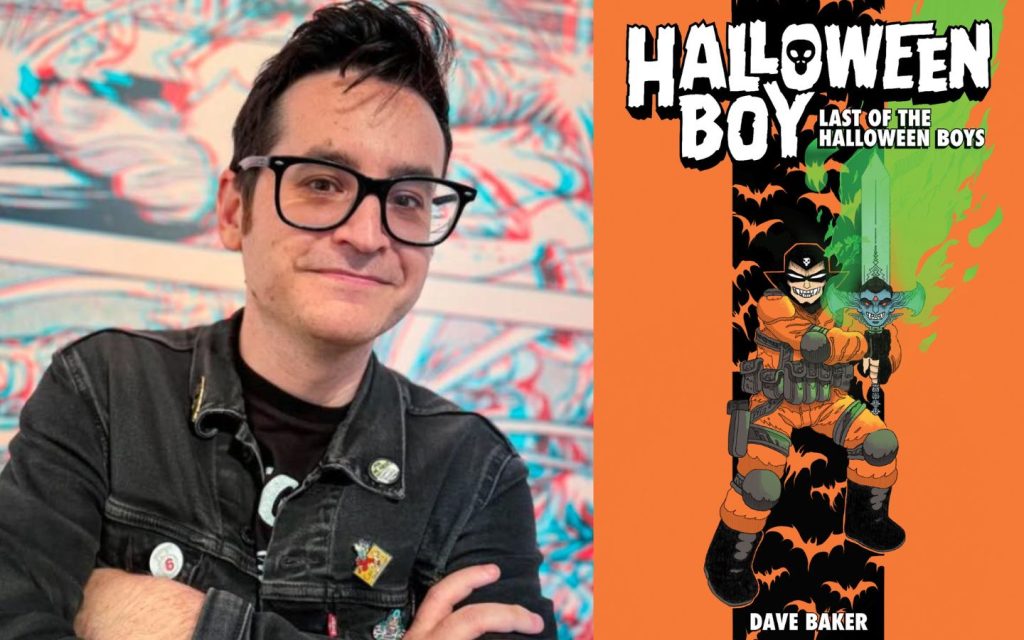
Dave Baker is one of those creators. And with Halloween Boy, arriving through Oni Press, he’s done something genuinely rare: built a hero back up from the wreckage.
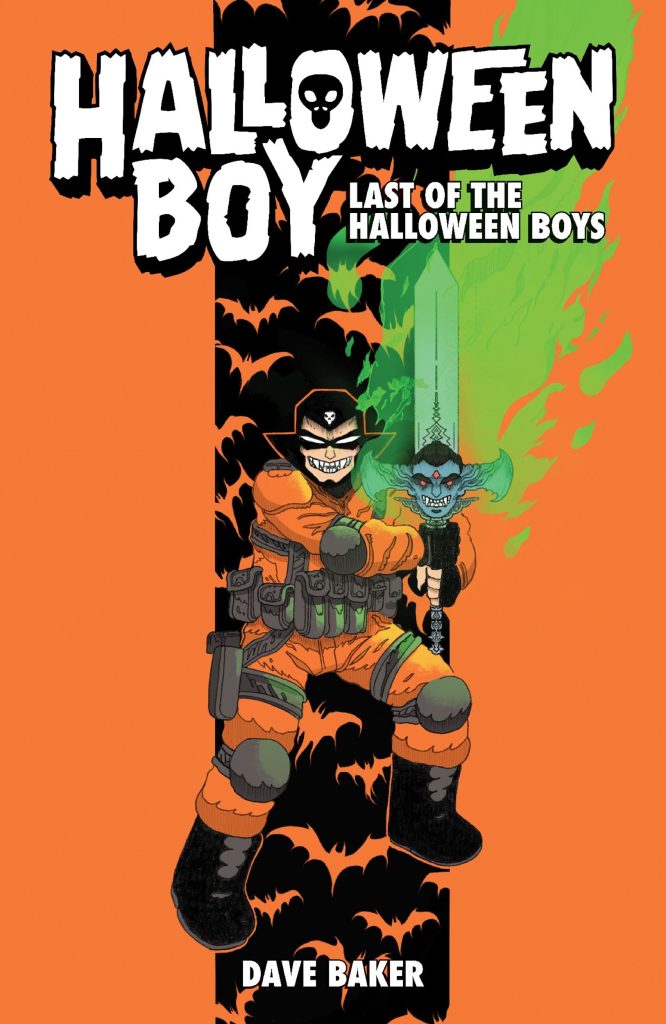
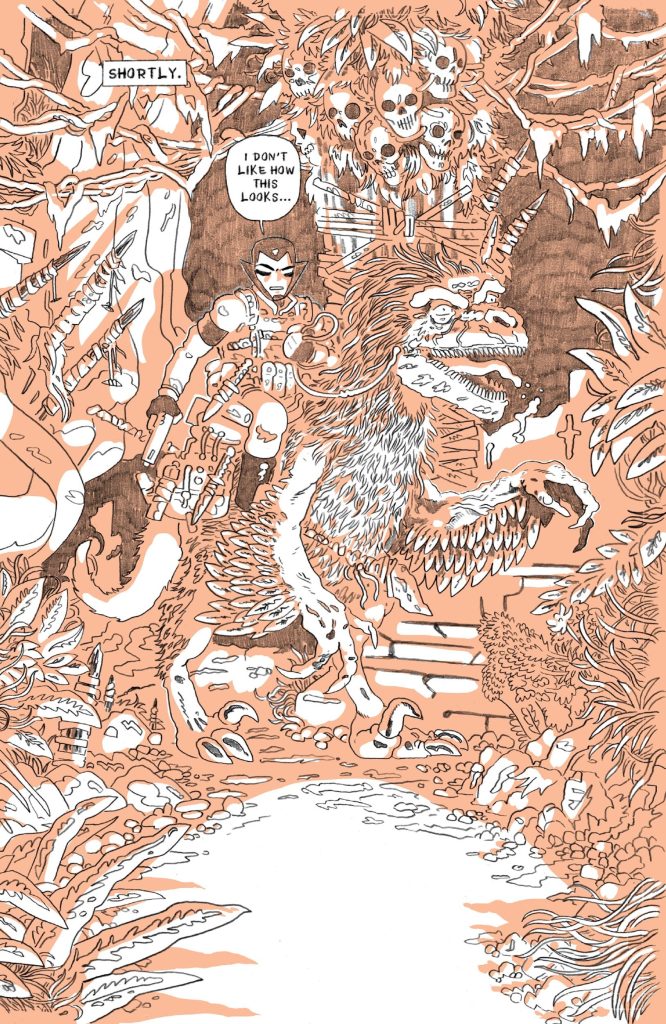
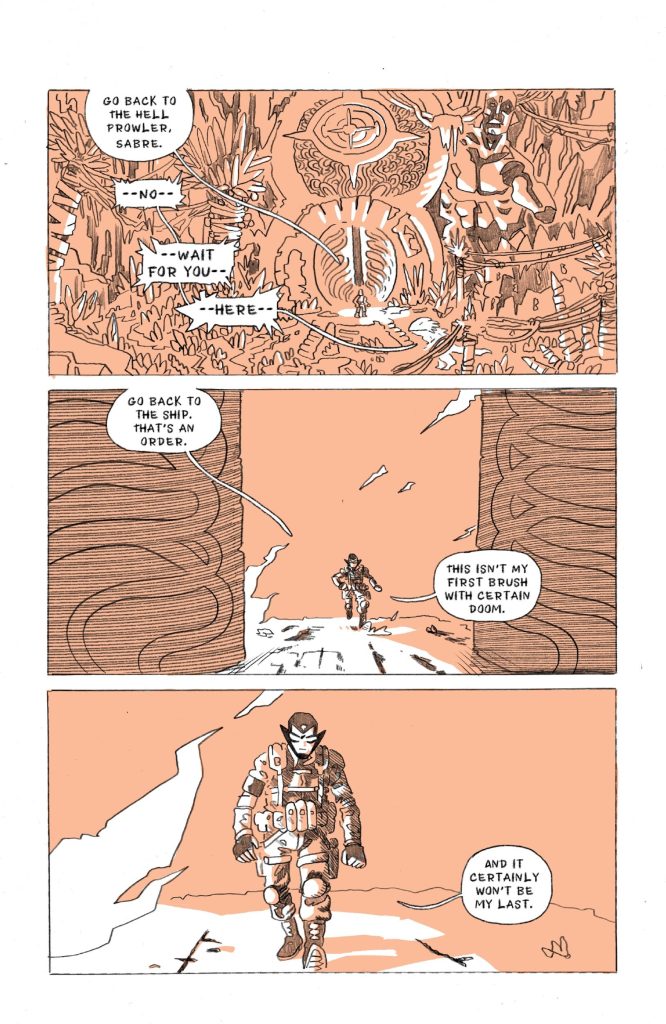
Part Doc Savage, part Ghost Who Walks, all attitude — Halloween Boy is a duotone action-horror comic drawn, written, coloured, and lettered entirely by Baker himself. It stars a man who calls himself the Patron Saint of the Impossible, fights monsters in space, and apparently has a haircut that Baker himself could only dream of. Volume 1, subtitled Last of the Halloween Boys, collects issues #1–5 of a series Baker has already drawn well past thirteen issues of. The man is not messing around.
I sat down with Baker to talk pulp epithets, weapons grade sincerity, a Phantom pitch that fell apart in the best possible way, and why in a world getting grimmer by the day, he wanted to make a hero who stares into the abyss and doesn’t blink.
An Interview with Dave Baker
Halloween Boy is your attempt at a “two-fisted adventurer for the post-superhero age” — which is a hell of a phrase, but also a slippery one. Forty years into the deconstruction project, what does a “post-superhero age” actually look like to you on the page? And is Halloween Boy a response to it, an escape from it, or something stranger?
Dave Baker: Halloween Boy is a love letter to things like Doc Savage, The Phantom, and Hellboy. It’s an action-horror comic starring someone who thinks of themselves as The Patron Saint of the Impossible. So, if flaming swords, talking dinosaurs and masked inter-stellar vigilantes sound like your thing, this is the book for you.
Since the seminal deconstructionist texts of the 1980s, like Watchmen and Dark Knight, comics has been learning all the wrong lessons from those admittedly impressive works. With Halloween Boy, I set out to do the opposite. I set out to look at the classic comics of the pulp era that I loved, bring the tropes up to current day, and then reconstitute a genuine attempt at making an adventure comic that both grapples with the dark past of its predecessors and is remolded into something new, exciting, and completely unique.
You’ve said the medium has spent forty years tearing the hero apart. That’s a long shadow to step out of. Was there a specific moment — a comic, a film, a panel, a bad day — where you thought, enough, I’m building one back up? Or did the impulse arrive quietly and only make sense in retrospect?
Dave Baker: I’m a huge fan of the Phantom. A few years ago I was in talks with King Features to get the rights, and I had to write a bunch of “God Docs” to communicate the vision. I wanted to make a Phantom comic that grappled with the real legacy of the Walker family. Something they initially seemed into, and then eventually backed away from. So, when that project fell apart… I decided I’d make it myself. I’d use the pieces of that pitch which were the most interesting, and I’d build out a more and increasingly complicated world, and I’d see where things took me. Well, look at that. It took us here. Last of the Halloween Boys, indeed. [laughs]
RELATED: An Interview with the Creator of ‘PALOMINO’ : Stephan Franck
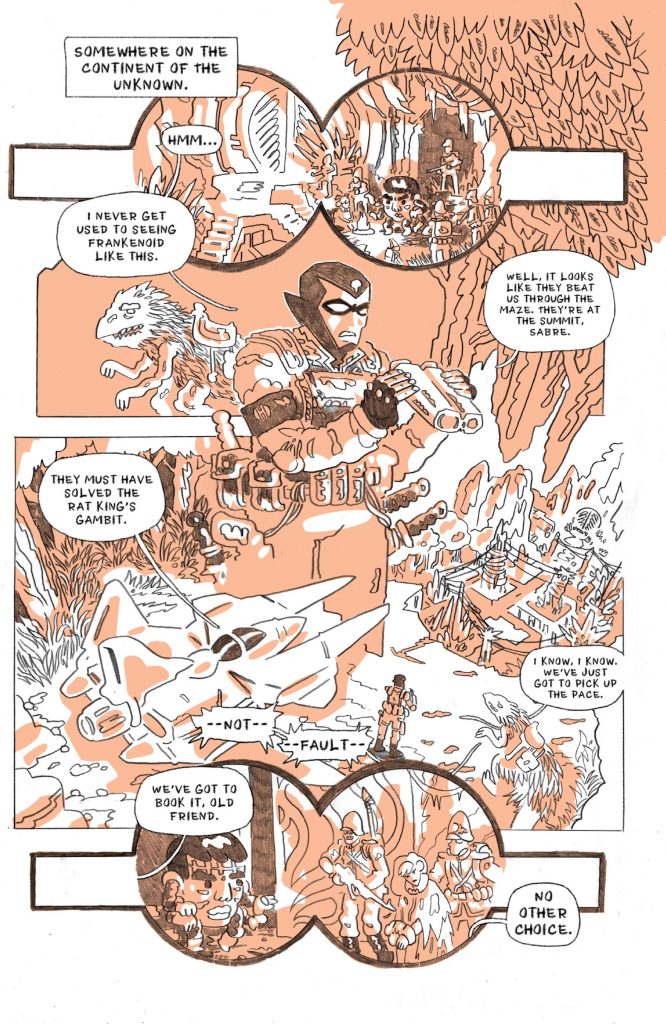
Halloween Boy is duotone from cover to cover — written, drawn, coloured, and lettered by you alone. There’s a particular kind of restraint in that, and a particular kind of freedom. What does pulling that many colours out of the room actually do for you on a page? What gets louder when everything else gets quieter?
Dave Baker: I had just come off making Mary Tyler MooreHawk, and I felt like I had relearned how to draw while making that book. So, this project was me trying to pull out all the stops. I wanted to take what I had learned and crank up the volume. Do a down and dirty punk song. And I think doing a single tone comic is part of that. If I had to full-color every page? It would have taken me three times as long. I just wasn’t interested in that process. So, I just wanted to make this book as direct as possible. And, I hope, it succeeded in that. I guess we’ll find out when the readers get a good look at it.
“The Demon Who Lives.” “The Man of a Thousand Fates.” These are pulp epithets in the proudest sense — the kind of names that sit on a cover and dare you to look away. Where did they come from, and how much of the book’s whole personality is wired into that naming tradition?
Dave Baker: I love subnames and nicknames. So, y’know. They’re pretty direct homages. If you know, you know. But there’s a long tradition in taking these nicknames and warping them for your own designs. Superman? He’s the Man of Steel now. But before him? Doc Savage was The Man of Bronze. So, y’know. If you’re going to play in the sandbox, you gotta touch some of the toys, right?
The pitch describes Halloween Boy as a deeply personal reflection on family, fraternity, and purpose — which is a long way from the megalomaniacal villains and interplanetary warfare on the surface. Without spoiling the book, how much of your own experience of fathers, brothers, and the long shadow of legacy ended up smuggled into a guy who fights monsters in space?
Dave Baker: Yeah, I think all art is autobiography at the end of the day, right? I’ll just say this, I wish I had a haircut half as cool as Halloween Boy.
RELATED: An Interview with the Creators of ‘Fort Psycho’: Matt Kindt and Brian Hurtt
Mary Tyler MooreHawk was a metafictional hall of mirrors. Halloween Boy sounds like the opposite — earnest, sincere, almost defiantly so. Is that a deliberate handbrake turn after MooreHawk, a project you needed to make to clear your own head, or were these two books always running on parallel tracks in the back of your mind?
DB: Yes. Absolutely it was a choice. I didn’t want to pigeon hole myself. I wanted to take some of the themes I’d been working in and distill them down, and then build them back up again with Weapons Grade Sincerity. I’m over the Ironic Hero. In a world where things are getting more grim and surreal every day, I want someone who’s going to stare into the abyss and not blink. So, that’s what I made.
Halloween Boy uncovers ugly truths about his father. That’s an old, old engine — you can trace it from Doc Savage to Star Wars to Invincible — and almost every iteration ends up doing roughly the same thing with it. What did you want to do with that archetype that you felt the medium hadn’t already done to death?
DB: I guess you’ll have to read the book and find out.
Hunter Gorinson called your work “a psychic vortex through eight decades of comics history” — which is a beautiful sentence and also an enormous claim. When you were actually drawing Halloween Boy, whose ghosts were closest to your shoulder? Which eras, which artists, which forgotten back-issue corners were doing the haunting?
DB: Absolutely. I’m a hardcore fan of comics and its history. Everyone from Fletcher Hanks to Doug Wildey to Alex Toth. There’s lots of references, both overt and subtle in the book. I’m pretty thrilled with how it came out.
RELATED: An Interview with the creators of ‘Parapsychologist’: Taki Soma and Mark Schey
Mary Tyler MooreHawk had a clear champion in Chris Staros at Top Shelf. Now you’ve landed at Oni Press, with a publisher under new leadership and a new visual identity. What was the conversation like, and what made Oni feel like the right room for this particular book — as opposed to keeping it in the underground or going back to your previous home?
DB: Hunter approached me about doing something with Oni at Emerald City Comic Con. We had quite a few discussions. And through that process I’ve become very impressed with his passion for comics, his ability to build on what’s come before, and his desire to make the industry better. I’m pretty thrilled with how Halloween Boy came out. And that’s all thanks to Hunter and Oni’s passion for the material.
Volume 1 is subtitled Last of the Halloween Boys, which is a hell of a tease — there’s a whole word in there (“last”) doing a lot of heavy lifting. How much of the larger mythology is already mapped out in your head, and how much are you leaving for the book itself to tell you as you keep going past May 2026?
DB: This first volume collects issues 1-5, I’ve already drawn issues 6-13. I’m pretty thrilled for people to see what’s coming next.
Thanks for your time.
DB: Thanks a lot. Really appreciate it!
What did you think of this Interview?
Will you be picking up Halloween Boy Vol. 1: Last of the Halloween Boys? Let us know on social media.
More in Comics, Interviews