Previously on Blam & Glam
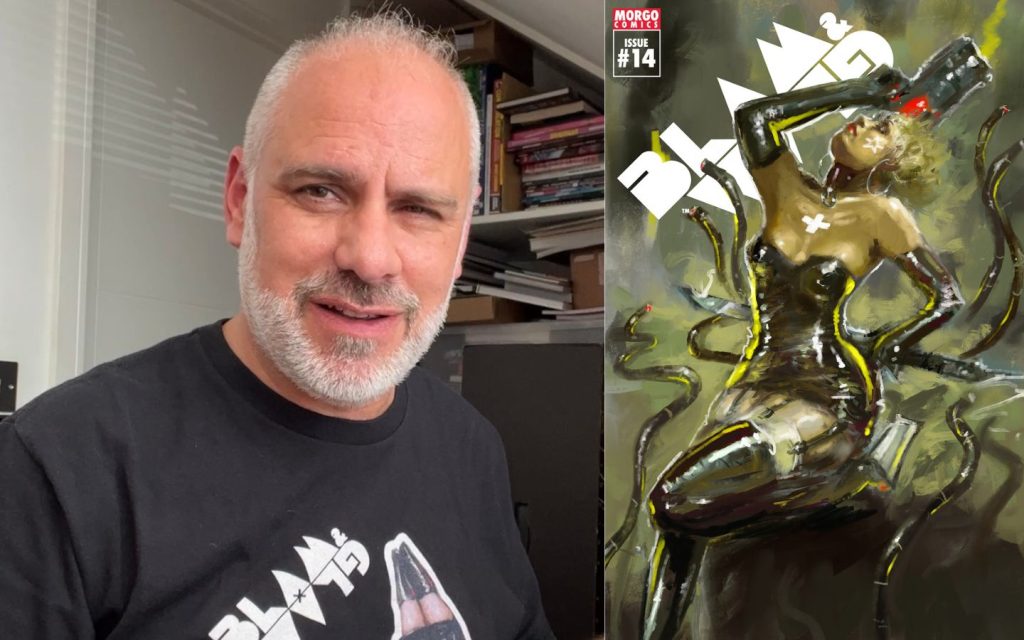
Richard A. Morgan (who I’m just going to call “Morgo”), an East London advertising creative, has been building Blam & Glam alone across fourteen Kickstarter-funded issues — writing, drawing, and digitally painting every page. Set in a deserted 2020 London overrun by Demonic Mecha machines called 6Eyes, Blam & Glam follows a nameless amnesiac woman who wakes up competent, violent, and dressed in a way nobody can explain yet. The pandemic became the premise when Morgo, laid up with a slipped disc the week before the UK locked down, watched deserted cities play out on the telly and realised the Pandemic had become a ‘Pan-Demonic’.
The series draws on a lineage running from Pat Mills to Ashley Wood to Hideo Kojima, filtered through 26 years in advertising and a lifetime of serial side-hustling. Glam’s identity is constructed in real time alongside the reader, her companion is a broken talking gun, and the slow reveal of who she is and why she’s dressed like that has been layered across both seasons deliberately and without apology. About 60-70% of backers are American, Bleeding Cool has floated major publisher interest, and Morgo’s answer to all of it is the same: he owns it, he tells it his way, and he is his own boss.
Interview with Richard A. Morgan
Blam & Glam begins with one of the oldest and most load-bearing questions in genre fiction — a woman who wakes up with no memory of who she is or what happened to the world — and then plants her in a very specific version of 2020 London, deserted, ruled by Demonic Mecha machines called 6Eyes, with the COVID pandemic reimagined as an apocalyptic takeover. That’s an enormous amount of world to build. Did the pandemic give you the premise, or did the premise arrive first and the pandemic simply provided the texture?
Richard A. Morgan: When I first created the character of Blam & Glam, I was imagining her in a post-apocalyptic London, but I didn’t really have the context for why it had happened. She wasn’t an amnesiac yet. I spent ages thinking about what drove the world to be the way it was. In early paintings and sketches, she was there, dressed like she was with a gun battling some sort of demons. In other sketches, she was scavenging for parts from the demon Mecha. But it all lacked the real WHY.
I knew I had to kickstart publishing my own comics and in 2019, whilst the story wasn’t ready, I decided to collect my sketches and paintings into a sketchbook which was my first ever kickstarter experience and it funded! I was blown away. In it were some pages of a weirdly drawn Blam & Glam story, but it wasn’t there yet.
Wind the clock forward to a year later, and a week before the pandemic hit, I’ve just moved house. In moving boxes and furniture, I put my back out. I was in agony for a week. A week of going to the doctor and the hospital and them just prescribing stronger and stronger pain meds, which weren’t working and I stopped taking. I found a physio and booked an appointment.
He confirmed it was mechanical, I had a partially slipped disc, and no end of tablets would help. Instead, he manipulated my back, gave me exercises to do and I spent a week on the floor doing them and it started, slowly to help.
By this point, the entire of the UK shutdown to work from home and the pandemic was in full swing. Day in and day out, I was exercising on the floor, watching the scenes of deserted towns and cities, play out on the telly, with the endless daily count of the pandemic’ toll in the updates with Boris Johnson, our PM at the time. It was then I knew I had the start of my ‘why’, and as you beautifully put it, it became a super-rich texture to create the setting for the world and for ‘Glam.’
The ‘Pandemic’ had become a Pan-Demonic.
RELATED: An Interview with the Creator of ‘Boston Metaphysical Society’: Madeleine Holly-Rosing
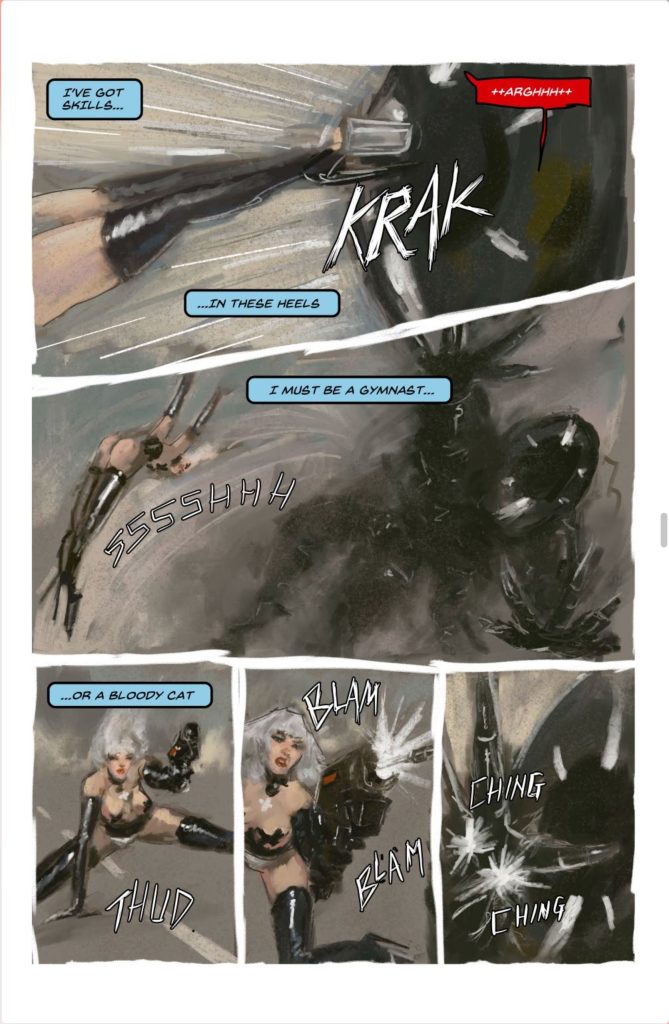
The unanswered question running through Blam & Glam — “Why is she dressed like that?” — is doing something very particular for a fourteen-issue arc. It’s a hook, obviously, but it’s also a kind of defiant absurdism, a refusal to explain itself right out of the gate. At what point in the story does that question get answered, and was there ever a version of the book where it got resolved earlier?
Richard A. Morgan: It’s interesting, before making comics, I was exploring painting on my iPad with portraits. I started painting every single day on the train to and from work, at evenings, weekends, just learning how to capture people.
For me, Glam’s dressed like that because I loved painting portraits of people who wear these clothes. There’s a confidence they have, whoever they are, whatever their body shape, to carry it off. The clothing transforms them when they wear it. And when you walk past someone, who wears clothing that’s different to the everyday, you instinctively take a second look.
The answer to the question, ‘why is she dressed like that’ gets answered in pieces across all issues of the comics. I don’t want to spoil the why, because it’s layered into all the (Blam & Glam) issues in series one and now in series two as well. It doesn’t stop revealing itself, which plays into the story of her missing memories, and so it’s layering it in to understand more of who ‘Glam’ is over time.
The thing I get from readers, over and over is, in the run up to a Kickstarter and receiving the new issue, everyone re-reads the issues before, some read all of them, so they can remember fresh as we reveal more and more. They are looking for the reveals. I always gravitated to characters wearing shiny clothes like The Goblin Queen, Storm, Rogue and Jean Grey in the X-Men comics.
And you’re right, what she wears is a hook and I play to that. I use her and how she looks as the vehicle to pulling people into the comic, people who might not normally have read the kind of story I’m telling, particularly with it’s diverse cast of characters. There’s plenty of comics out there from diverse creators connecting to diverse audiences. I wanted to come at that from the other end. By targeting the people who might be put off by the label of ‘diverse comics’ who should really read them and learn from them.
The core of the Blam & Glam story is about society and people living on the fringes; those overlooked for not conforming. I grew up in multi-cultural East London in the 80s and my friends were from all different ethnic backgrounds. A real melting pot of worldly cultures that intersected at being British. I loved it. I was personally quite a misfit and banded with several different groups of friends, learning about them and about myself.
Over the years my groups of friends expanded, not just face to face, but across the world in socials, chatting to even more diverse people: not just culture and skin colour, but all different genders and sexualities. In this alternative 2020, I wanted to create a story of all us banding together to fight a common foe that a greedy government had aligned to. A foe that wanted only the strongest, the most confirmative people, rejecting everyone who didn’t fit that mould.
And about 90% of those people who came for the art, stay for the story. As to if there was an earlier version of the book where it got resolved early on, not really. It was all connected to the pan-demonic and the slow reveal of who she would be.
RELATED: An Interview with the Creator of ‘Night Ghost’: Lee Saunders
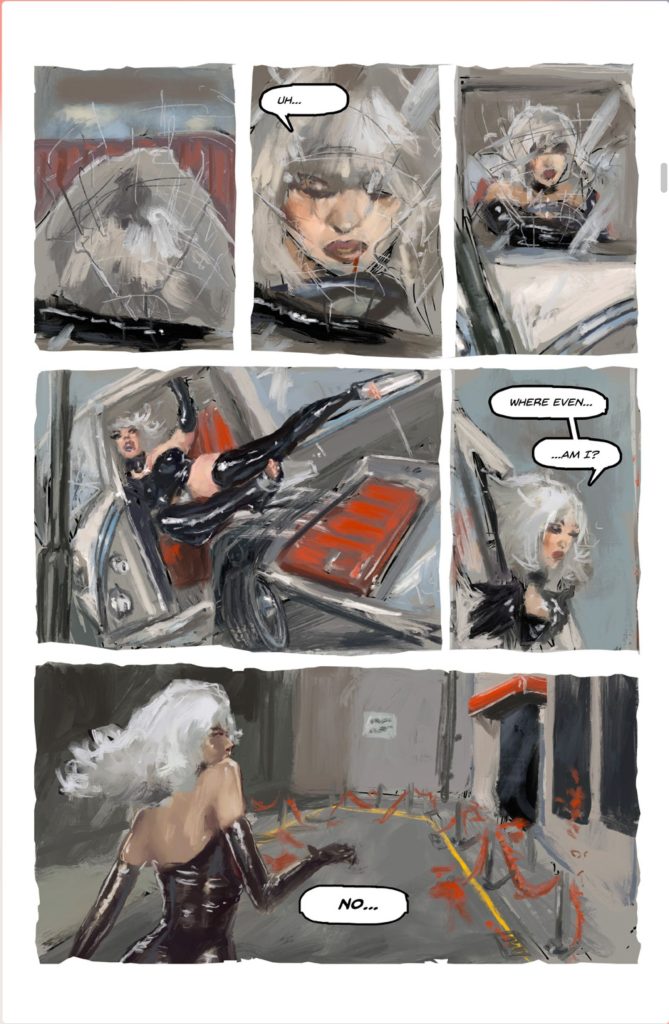
The 6Eyes — Demonic Mecha machines hell-bent on owning and enslaving mankind — sit at a very specific intersection of body-horror and military hardware, the organic and the mechanical. There’s a long lineage of that in British sci-fi, from 2000 AD’s ABC Warriors onwards, but Blam & Glam has been described as having the kinetic power of Rob Liefeld married to the over-the-top political satire of Pat Mills. How much of that comparison feels accurate to you, and how much of it obscures what you’re actually doing?
Richard A. Morgan: I love that comparison. I am deeply honoured Rich Johnston of Bleeding Cool, who I’d worked with in a previous life, saw those influences in my work. When I was a kid in 1982, the ‘Eagle’ comic had been reborn. Eagle was originally a comic from the 1950s-70s, something for my dad’s generation. In the 80s, after a running success with 2000 AD, the publisher decided to reboot Eagle. 1982 Eagle was my first ever real comic. I wasn’t a fan of the Beano or Dandy. I hadn’t read American comics yet. But Eagle had the Great, Great Grandson of the Legendary ‘Dan Dare’, from the pages of 1950s Eagle comic.
I didn’t know at the time, but in reading that and being smitten by the future and tech, I was reading a Pat Mills comic, and I also didn’t know it, but his political satire was baked into 1982 Dan Dare and I was subconsiously picking up on it.
I had never actually read 2000AD. I had seen it here and there, read the odd Judge Dredd or ABC Warriors story. Later in life, I had seen both Judge Dredd films. Dredd with Karl Urban is by far the best telling and brilliantly played. Eagle comic was my thing. The weaving of that first story Return of the Mekon started with Dan Dare returning home to a place that had been taken over by the Treens and the Mekon and it was mind-blowing. Then, when Pat wrote the next phase of the story, The Dare Report which linked 50s Dan Dare with the 80s Dan Dare, it was incredible – bending time and space. It was an alternative reality that changed Britain post the Second World War. I’ve always been a sci-fi nerd. I love both the Star Wars and the Star Trek films. Doctor Who, a ton of 80s sci-fi films. Tech was a big thing for me to play with too.
In terms of art, Rob Liefeld is a creative genius. He found his style, ripped up the rule book on panels and page, and changed how characters were made. His kinetic comic pages are pure fun and to be compared, even slightly to that, is very humbling.
And I don’t think it obscures what I’m actually doing, I recognise that they were both doing something different with comics. To be honest, most of the time I don’t actually know what I’m doing other than having fun trying to create my own story, weaving in culture and history, dabbling with political themes of the moment and trying to paint it by the seat of my pants in the little time I have outside of my quite demanding, but cool advertising day job.
It’s funny, the mecha idea, especially in the finale of issue 8 with the MEGASTATOR (that’s such an OTT 80s name, right?) came from an idea I was playing around with for a TV ad, a long time ago, that I could never get working. It was an idea that some mysterious power, originally music, could assemble tons of everyday tech into a giant dancing robot with onlookers marvelling at the sight and joining in busting moves. So I took that failed idea, and developed the Demon Head that could assemble a mecha boss level machine for the heroes to fight.
RELATED: An Interview with the Creator of ‘The Goblin Throne’: Mel Gillman
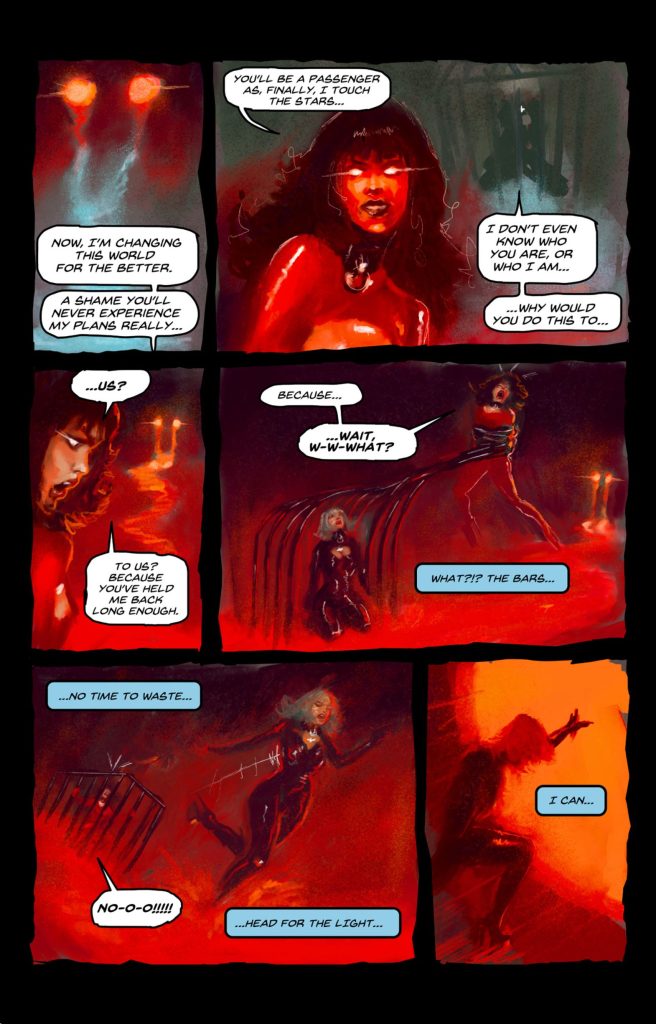
You’ve taken Blam & Glam from London out to the world across fourteen issues — which means Blam & Glam has the architecture of something that always knew it was going to expand. Was the global scope part of the original plan, or did it become clear somewhere in the first season that the story needed more room?
RAM: Interesting. We’ve started to see the effects of the Pan-Demonic spread to the wider world, beyond London, but it’s still in the UK. The outside world is a mystery to us. The spread isn’t just geographical, but also across time. The benefit to someone having amnesia is that they start to remember things. That she, and also other characters, remember or know of, of events beyond their lifespan, is a testament to a duality of ‘Glam’ that we discover at the end of season one and into season two. Again I can’t spoil it, but is she what you think she is?
Similarly, are events happening in the comic pages when you think they are happening. This becomes a theme that messes with people’s heads. In this instance, I want the reader to be experience a lot how Glam experiences the world. Those who have read the story so far, know we’ve also ventured far beyond the realms of this world. So, it starts to get ‘more room’ in time, space and multiple dimensions.
It was always going to be interesting to see where the demons come from. How we would do that needed a pivot in the story, which happens bang at the end of season one, but we didn’t know it until season two.
That room, wherever we expand, was needed to bring in fresh characters and side stories, all linking to the main narrative and driving it forwards.
Glam’s amnesia is total enough that she can’t even remember her own name — and yet she’s competent, violent, instinctual, and apparently already dressed for something we don’t understand yet. That’s not the amnesia of someone who has forgotten; that’s the amnesia of someone who has been reset. What drew you to writing a protagonist whose identity is almost entirely constructed by the reader in real time, rather than revealed?
RAM: It’s interesting in that amnesia can be triggered in different ways. Normally as some sort of trauma. That this isn’t a run-of-the-mill type of amnesia opens up the question, why can’t she remember when, as you say, she’s fully competent and violent. She’s has been reset – I love that and never thought of it that way, but this is down to an event revealed across many issues. The ‘instinctual’ part is also a great observation, especially when we start to realise who she is. Again, I’ll tease the word ‘Duality,’
What drew me to writing her that way was you got to experience the world like she did. I’m not one for stopping and talking, so I needed a way for her world to be explained to everyone as they discovered it. I wanted it to be visceral in how its all revealed.
When the TV series Lost came out in the early 2000s, I was smitten. The way it dropped you into the narrative and revealed the world was mind-blowing. I bought the making of book and everything. I studied it. I went on the journey with them. And that taps into your next aspect of that question about reveal vs construction.
The idea of Blam & Glam being constructed in ‘real time’ is something I hadn’t realised I was doing, but I think it was ‘instinctive’ as you say. I write a lot of it subconsciously, if that’s possible. I’d be out walking the dog, out running, in the shower and always I’m thinking about the story. That it could enable the story to form that way, was a bonus feature. I’ve only ever written one creative thing before. It was a terrible screen play in my college days. It’s something I might return to as a new comic. But It was awful. It was plodding, talked too much. Revealed badly. So I knew I had to write different.
Her relationship with Blam — a gun that functions as both sidearm and sidekick — is one of the stranger creative decisions in the book. Giving Glam a weapon as her primary companion rather than a person changes the emotional register of the Blam & Glam series. Was that always the dynamic, and what does it let you do narratively that a human partner couldn’t?
Glam needed someone she could connect with as she learned about the world. Only she could understand what ‘Blam’ was saying when he went ‘Blam Blam’. He’s a broken talking prototype weapon. He doesn’t change ammo functions with words, but instead responds to child-like sounds. Glam connects with broken things and people. Mirroring how she feels. Blam had to be something she could interact with but not hold conversation. He needed to be a comfort blanket, if a weapon can be that.
RELATED: An Interview with the Creator of ‘Urbance’ : Joël Dos Reis Viegas
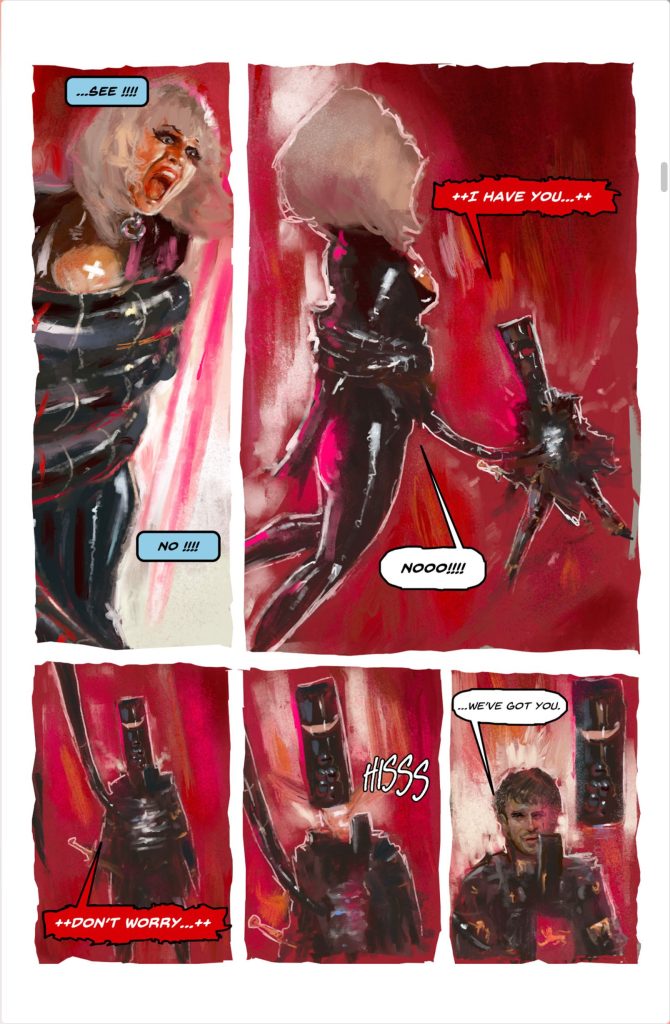
Blam & Glam is fully written, drawn, and digitally painted by you, solo — and you came to it from a career as an art director at Grey, one of London’s major advertising agencies, rather than through the traditional comics pipeline. Those are completely different disciplines with completely different relationships to image-making — advertising trains you to compress meaning, to seduce in seconds, to land a single clear idea. What habits from that world survived into the comic, and which ones did you have to actively fight?
RAM: It’s funny, that agency, which I’m still at 26 years later, just under a different merged company name, is where I met Rich Johnston! Yeah advertising had many lessons from me to learn and then apply later to my comic. I had first tried to break into comics back in 92’. I had been reading Marvel comics at the time. I had become obsessed with the XMEN family of comics whilst at college and tried to draw comics. And then the Image publishing thing happened and my favourite artists jumped ship.
I had been drawing black and white Star Wars comics in the traditional ink way to show to prospective companies. At that time Star Wars was almost dead and the Special Editions were still 2 years away which led to a later resurgence. I went to a comicon in London with my school and college friend David Stokes. We were into X-Men and his comic art was infinitely better than mine. Still is!!! Anyway, I showed the pages at this con to one person as we had missed the whole panel. He wasn’t impressed by the art, rightly so, and then I quit the idea and went into advertising.
However, when I started working, not only was I to make ads of sorts, but because I had digital web making experience and, because I taught myself special effects and editing, I started to take on motion work at the agency.
I was writing, storyboarding, pre-visualising scenes in photoshop, 3D modelling (CGI), filming, lighting, matte painting, compositing, sound and music editing, film editing too, all of which led to new opportunities. I got to direct some TV commercials instead of just creating the ideas for them and art directing them. This was my superpower, I could bring all of these skills and marketing to the mix of making the comic.
Landing a single clear idea with something like Blam & Glam isn’t something advertising helps with. However, it helps land the single idea in a scene or a panel. When to be mysterious, when you need to let the audience fill in something as you acknowledge how smart they are. They will draw conclusions on their own, you don’t have to spell it out.
Telling someone the story in one sentence is the thing I have to fight. It’s probably why Blam & Glam is a hard sell. I can’t tell them what it’s really about. That would ruin it.
If you’ve ever played Hideo Kojima’s PS4 & PS5 game Death Stranding, the reviewers try to sum it up as a ‘walking/delivery game’ but it’s not that at all – that’s just the engine. It’s really an indescribable experience, in a world made strange by extinction level events and it’s your job to emotionally unite a physically-divided continent. That it has so many layers to the story that you reveal is amazing. I wanted something like that and I hadn’t even played Death Stranding yet. Funny how it was predicting the Pandemic experience we’d have, just it two years ahead of its time.
The digital painting approach gives Blam & Glam a visual texture that reads nothing like traditional line-and-colour comics work — it’s been called sketchy, kinetic, dreamlike. Ashley Wood is the obvious reference point for that kind of fully painted, loose, high-energy aesthetic in comics. How conscious is that influence, and where do you think the work diverges from it?
Thank you so much !! Yeah Ashley Wood is a massive influence. Bill Sienkiewicz with his Elektra Assassin, one of my favourite comic series of all time. With Ashley, my first experience of his art wasn’t comics, it was cut scenes in the SONY PSP Metal Gear Games. I’m a massive Hideo Kojima fan, and Yoji Shinkawa who’s the art director on all of Kojima-san’s playstation games. In MGS Portable Ops and later MGS Peacewalker, Ashley did the cut scenes and I was blown away. It was like Shinkawa-san’s art, but had its own storytelling energy. It led me down a rabbit hole of his comics, paintings, drawings and figures!
When I was in advertising, I worked with a lot of CGI artists and designers and one of my ways of working is to ‘block in’. I was taught that when I first started working designing websites. Block it in, feel the energy of the page and then work the detail. So this became my thing.
But my style for this wasn’t never the original intention. I always wanted to draw like Jim Lee (impossible) and so I was trying to draw comics like Ashley Wood’s ‘ink’ style and I was failing. In my ad agency at the time, my friend Adam Buxton who was a Creative Director and is a comic fan, was asking me “how my comic was going” and I said to him about the style and how I was failing at it (1992 all over again). And what he said stopped me in my tracks and caused a style pivot.
“What are you doing, dude? Why aren’t you doing a comic in your painted style?”
And that hit me. So I started experimenting with painting and that led to the original Kickstarter sketch book. Then I was really inspired by the other side of Ashley Wood’s work, the loose and kinetic style painting.
It’s basically a style that frees me from detail. It means, I can paint abstracts for scenes and spaces, capturing the emotion and movement of the moment. I add detail to focus the eye to one place, something I learned from matte painting. And then I was all set.
RELATED: The Adult Performer Defying Expectations: An Interview with Lady LorReign
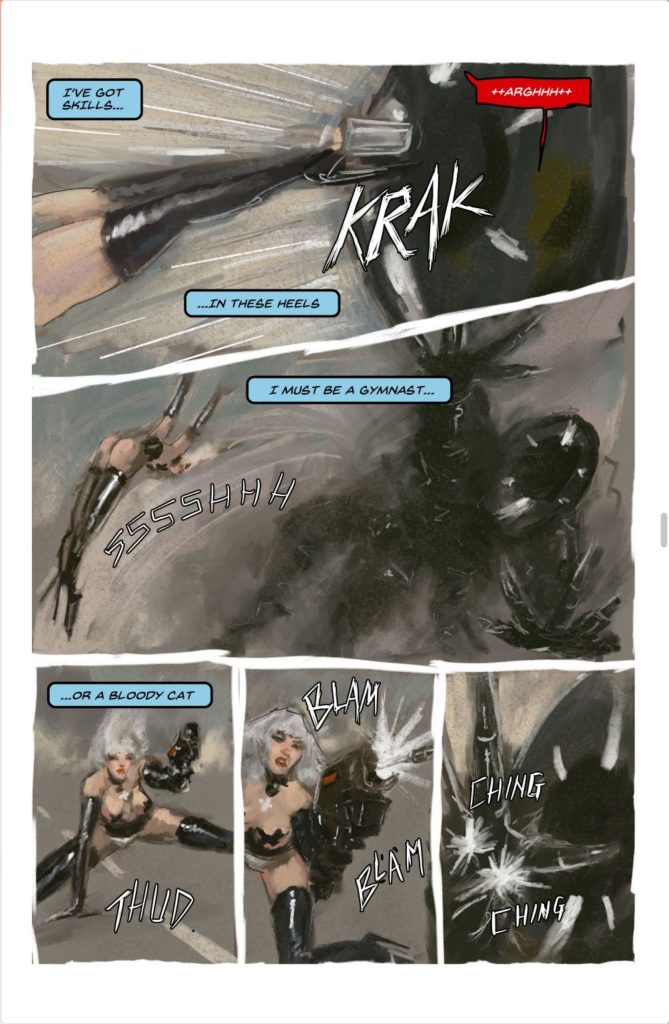
You’re now at issue 14 — which means you’ve been sustaining this solo, self-published, fully painted series for several years, across two seasons, through Kickstarter alone. At what point in that process did Blam & Glam stop feeling like a project and start feeling like a practice?
RAM: I’m a serial side hustler. I’ve been doing it since school when I was making music on an Atari ST with drum machines, samplers and keyboards. I’ve always had a curiosity to make things. As an artist, it’s something I can’t switch off. So, even before painting digital portraits of people, I was coding games on my iPad to and from work. They were published on the App Store or 6 years and then I had to stop paying for the licence and updating the software as I wasn’t learning from it any more.
Coding on the train became painting people’s portraits on the train (learning how to paint again) before it became creating comics on the train. I’m a ‘commuter-prenure’ – I coined that phrase back in 2016 I think it was.
So for all my life, it’s never been a process, just part of who I am. That it’s not integrated into my professional life, as I live a dual life now, is where it’s a practice. I’m like NEO in the Matrix. By day I’m an advertising creative at an agency, with bosses to follow and I pay my taxes. By night I’m a comic creator, who’s my own boss under the comic guise ‘Morgo’ and yep I still pay my taxes on these too.
Bleeding Cool has floated the idea of Image, Dynamite, Boom, Titan, IDW, or Dark Horse coming for Blam & Glam — the suggestion being that some US publisher is going to look at the thirteen issues and realise there’s an American market waiting for it. How do you feel about that possibility, and is there a version of this book that could survive a traditional publishing pipeline intact, or would the thing that makes it what it is get smoothed out in the process?
RAM: When I look at my kickstarter backers, about 60-70% of them are an American audience. About 20% UK and the rest split all across the world! So it’s making heavy inroads into the US already. I would love it to move into a traditional publishing pipeline, under someone like Image comics or similar. I have 14 issues ready to go if they do. But I own it. I also choose how I tell the story. I wouldn’t change it for a company, but some of the art I would revisit if it ever did. There’s panels I’m not happy with and want to tweak. The odd mistake here and there too.
I had a retailer want me to change my story when I was doing a bespoke cover version for them of Blam & Glam to sell on their online store, right at the beginning with issue 1 & 2. We parted ways amicably because this is my creation. I tell it my way. I make my mistakes. I do listen to some feedback from creators and friends, but I cherry pick what’s right for my story. I am my boss.
The variant cover economy around Blam & Glam — the naked variants, the virgin variants, the guest artist covers from the likes of Stjepan Šejić — reflects a very particular corner of the direct market and its relationship with collector culture. That’s a deliberate choice about who the book is for and how it circulates. How do you think about that economy, and does it shape anything about the book itself?
RAM: Great question. Naked in some variant covers is a deliberate choice about the character. It plays into part of Glam; it’s not all what she’s about, nor is it the main story, but she’s bold and confident to know what she wants in times in her life. You said it right, she’s defiant. It’s her body and she’ll damn well do what she pleases. Of course, never in front of minors. The dynamic that plays with a family relation (all I can say to not spoil the series) talks to when she she can be that free outside of everyday things.
Guest artists economy are a way to see Glam from outside perspectives and also tap into those artist followers to unlock more readers for me. I always pay the artist fees up front and I’ve also paid bonuses when sales of their covers are profitable. I don’t negotiate on cover rates. If I can afford to do the cover with the artists for the fee they want, I do it and pay months before we get started on it.
Bangbez was of the first artists to trust in what we do and joined early on in issue 5 and does all our yellow covers ever since. He took a gamble on my comic and is my bestseller which pays off for us both. He has a great audience socially so that rubs off.
I had done a guest artist cover in issue 4, I think it was, that was a Benny & Jett cover clothed only, drawn beautifully by Studio MonkeysVsRobots, who are so cool. We then started to get guest artist variants with the PINK RANGE which started in issue 8, the finale of season one. That was Robert Sammelin (co-creator of Kali for Dark Horse) who did an amazing 3D cover, modelled, lit and textured – stunning.
Art can be hand drawn, painted digitally or painted physically or 3D CGI or a combination. But I will never use AI in our projects. That’s a huge no-no.
We then managed to get other greats for pink covers such as Suspirialand, who did original art that I then purchased for my collection, Luana Vecchio creator of ‘LoveSick’ and ‘Doll Parts’ for Image comics, Stjepan Šejić as you mentioned creator of ‘Fine Print’ and ‘Sunstone’ for Image comics, Adriean Koleric creator of ‘Trakovi’, ‘The Sitter’ and ‘Todd LeBon’ for his own company 3Press comics and then Brandon Graham co/creator of ‘King City’ and ‘Multiple Warheads’ for Image comics too.
Then for issue 14 I’ve landed a hot new artist who’s self publishing. It’s Samuel Dempsey of SkyDwellers Studios, creator of ‘Loumarin London’ who I met through a friend on instagram and then meet him face to face at MCM Comic-Con.
I, however, try to limit my covers to 5 designs. Standard and Red by me. Yellow by Bangbez. Pinks by guest artists, one per issue. Of course each cover has a tweaked nude variant based on their versions too. And then the ‘5th’ is a blank cover for people to draw on, or I ink or oil paint onto. I’ve seen lots of kickstarters have a ton of covers, and I don’t think that works. 20 plus in some cases. That says you aren’t being selective about who you work with and why.
In terms of what they produce shaping the book itself, not directly. That outside view of my character gives me confidence that people see something in her that connects with them.
In terms of the colours of the covers, they are influenced by the story. So standard is my cover and is the most affordable version. My reds are limited and tap into a moment when the sky changed in the story. Yellow picks up on an undertone of a scenario and setting that the story has been moving to for a reveal. And then Pink taps into the Demon world. It’s all about planting subtle cues into the story.
RELATED: An Interview with the Creator of ‘Halloween Boy’ : Dave Baker
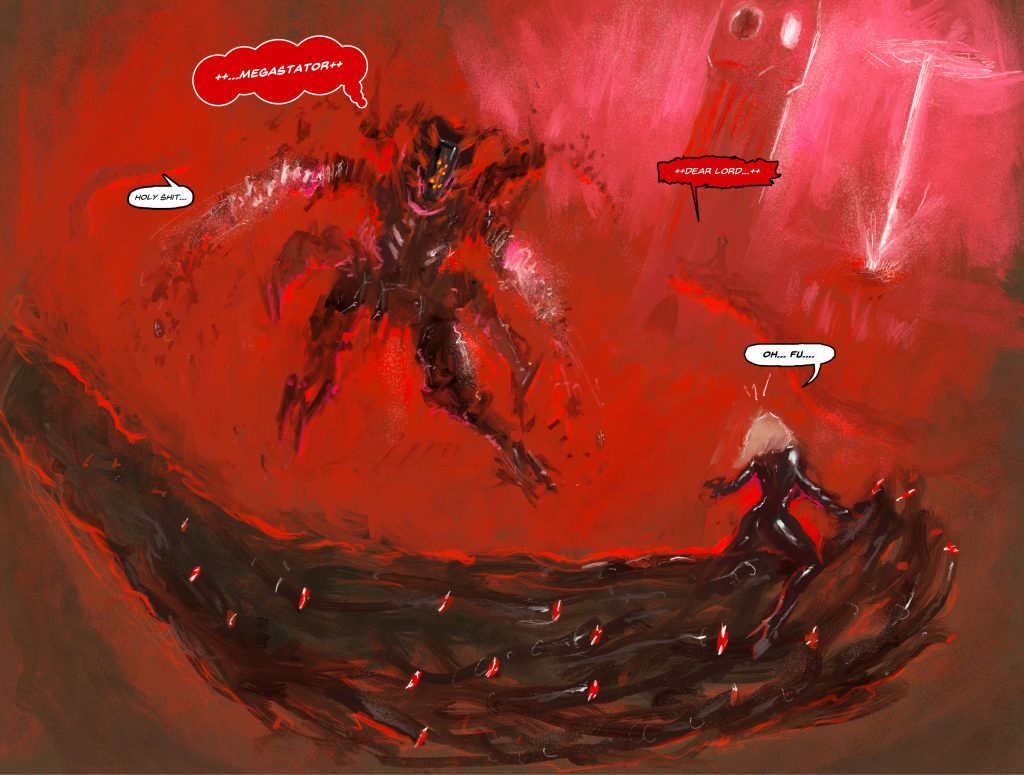
When Blam & Glam is finished — whenever that is — what do you want to exist that wouldn’t have existed without it? Not commercially. In the culture, or in you.
RAM: Yeah, working out when it finishes is interesting. Does it end with Season Two finale? Should season Three be a sequel or a prequel? I mean there’s side characters who have become main and have stories to tell, past and future. A Glam prequel, with her, wouldn’t be a demon / action thing, but rather a delve into the life she departed from when the Pan-demonic narrative hit, things that we tease throughout.
The biggest cultural thing I really wanted, was the ‘water cooler talk’ moment when people watched TV shows like ‘Lost.’ I know people talk about the comic and would love to have a chat board where they can offer up theories. One of my friends who we met on online chat boards making Star Wars fan films back in 2002, read the first issues and said she didn’t have a clue what was happening, but she said it was great! I like that. It’s kinda the point. Try to decipher this world yourself and read into it things.
The biggest thing that does, and I hope will continue to exist, is that I have works of art relating to her in places around the world. What started as A2 and A3 sized paintings people bought from the sketch book, blew out into A2 oil painting art for covers. The comics and the trade paperbacks being amongst them. That they are framed and hanging on peoples walls blows my mind.
I also want to create figures, and I don’t mean the 1/12 scale ones we made for some of the Kickstarters that people bought. I mean proper articulated 1/6 scale figures that Ashley Wood makes. With super cool art boxes and unboxing experiences.
Wow, that was all a lot to unpack, right?
Thanks for your time.
RAM: Thank you so much for all these questions. A lot to think about.
Will you be picking up a copy of Blam & Glam?
Did this Richard A. Morgan interview convince you to pick up an issue of Blam & Glam? What’s your favourite comic book series with a strong female lead?
Let me know in the comments.
More in Comics, Interviews, Kickstarter